
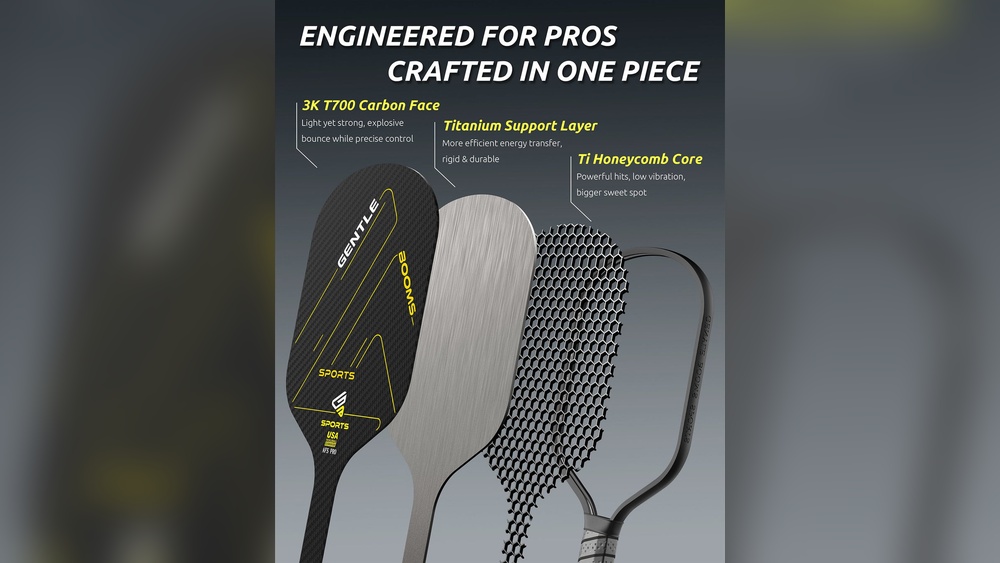
Pickleball has become one of the fastest-growing sports in the world, and the technology behind the equipment is evolving just as quickly. One of the most important choices a player makes is the type of paddle they use. Two common materials in advanced pickleball paddles are T700 carbon fiber and 3K carbon fiber. If you’re trying to decide between a Pickleball Paddle T700 vs 3K, understanding the differences can help you play better, protect your arm, and improve your overall game experience.
Let’s break down what makes each type special, how they perform in real games, and which one could be right for your style and needs. If you want to invest in a new paddle, this guide will help you make an informed choice.
What Are T700 And 3k Carbon Fiber Paddles?
When you hear people talk about T700 or 3K paddles, they’re referring to the type of carbon fiber used on the paddle’s face (the hitting surface). Both are strong, lightweight, and popular in high-performance pickleball paddles, but they have important differences.
- T700 carbon fiber is a high-tensile-strength material. It’s known for being stiff, durable, and responsive. The “T” stands for “Toray,” a famous Japanese carbon fiber manufacturer, and “700” refers to its strength rating.
- 3K carbon fiber describes the weave pattern of the carbon. “3K” means each tow (bundle) of fibers has 3,000 filaments. It’s a bit less stiff and has a slightly different feel than T700.
The way these fibers are arranged and layered affects the paddle’s power, spin, control, and even sound.
How T700 And 3k Affect Performance
Choosing between T700 and 3K isn’t just about the numbers. Each material feels different when you play. Here’s how they compare in real play.
Power
T700 carbon fiber is generally stiffer, which means more energy transfers from your swing to the ball. Players who like to hit hard, drive the ball, or finish points quickly may prefer this extra punch.
3K carbon fiber is a bit more flexible. It absorbs more impact, which can reduce power slightly but gives you more touch and feel on softer shots.
Spin
Both T700 and 3K paddles can generate great spin, especially if the surface is textured. However, the stiffness of T700 helps the ball leave the paddle more quickly, which can add extra spin if your technique is good. Some players say the woven texture of 3K feels “grippier” and easier to control for spin serves and dinks.
Control
If you want pinpoint accuracy, 3K carbon fiber can give you a softer, more forgiving touch. It absorbs shock well, which helps with blocks and resets. T700 is more precise but less forgiving if you miss the sweet spot.
Durability
Both types are extremely strong, but T700 is known for its exceptional durability. It’s used in aerospace and racing for a reason. However, the real durability of a paddle depends on how the manufacturer layers and bonds the carbon fiber.
Sound And Feel
Paddles with T700 faces tend to sound sharper, almost like a “pop.” 3K paddles usually make a softer, lower sound. If you play at indoor courts, this can matter more than you think.
What Matters When Choosing Between T700 And 3k?
When you’re shopping for a new paddle, the material is just one part of the story. Here are the most important things to consider:
1. Your Playing Style
If you love to attack and hit hard, T700 might give you the edge. Defensive or finesse players often prefer the touch and control of 3K.
2. Your Skill Level
Beginners sometimes find T700 paddles too stiff and unforgiving. 3K paddles can be easier to control, especially when learning.
3. Arm Comfort
If you have tennis elbow or arm pain, a 3K paddle’s softer impact can help. T700 can feel harsher on mishits.
4. Budget
T700 paddles are usually more expensive, but not always. Some brands use T700 as a marketing term, so check for real specs.
5. Brand And Build Quality
Not all T700 or 3K paddles are created equal. The resin, core material, and manufacturing process matter just as much as the face material.
T700 Carbon Fiber: In-depth Overview
What Makes T700 Unique?
T700 is one of the most popular types of carbon fiber used in high-performance sports equipment. It’s known for its:
- High tensile strength (4900 MPa)
- High modulus (stiffness)
- Light weight
- Excellent durability
This makes it ideal for players who want their paddle to last a long time and perform consistently.
How T700 Is Used In Paddles
Manufacturers like Selkirk, Joola, and Carbon use T700 in their premium models. It’s often layered in a single direction or woven for extra strength. Some paddles use T700 only on the surface; others use it throughout the face.
T700 In Other Industries
T700 is not just for pickleball. It’s used in:
- Aerospace engineering
- Race cars
- High-end bicycles
This reputation for strength and reliability has made it popular with serious athletes.
Performance In Play
Players who use T700 paddles often notice:
- Crisp, responsive shots
- More power on drives and serves
- Clean, sharp sound on contact
- Consistent sweet spot
However, the stiffness can make control shots more challenging for some.
3k Carbon Fiber: In-depth Overview
What Does “3k” Mean?
3K refers to a bundle of 3,000 carbon filaments woven together. The weave is visible on the paddle’s surface (it looks like a checkerboard). The weaving process:
- Adds flexibility
- Spreads out impact energy
- Creates a softer feel
Where 3k Is Used
You’ll find 3K carbon fiber in many mid-range to high-end paddles. It’s also used in:
- Car parts
- Drones
- Sporting goods
It’s not as stiff as T700, but it offers excellent control.
Performance In Play
Players who use 3K paddles often notice:
- Softer feel on contact
- Easy control for soft game (dinks, drops)
- Forgiving on mishits
- Lower sound, less vibration
If you like a paddle that’s easy on your arm and good for finesse, 3K is a great choice.
T700 Vs 3k: Side-by-side Comparison
To make things easier, here’s a direct comparison of the main features:
| Feature | T700 Carbon Fiber | 3K Carbon Fiber |
|---|---|---|
| Stiffness | Very high | Moderate |
| Power | Excellent | Good |
| Spin | High (with textured surface) | High (with woven grip) |
| Control | Precise but less forgiving | Softer, more forgiving |
| Durability | Exceptional | Very good |
| Feel | Crisp, responsive | Softer, muted |
| Price | Usually higher | Mid-range to high |
Practical Tips For Choosing Your Paddle
1. Test Before You Buy
The best way to decide is to try both paddle types if you can. Many clubs and shops have demo programs. Even 10 minutes with each can help you feel the difference.
2. Know Your Game
Ask yourself:
- Do I win points with speed and power? (T700 may suit you)
- Do I focus on control, drops, and soft shots? (3K may fit better)
3. Don’t Be Fooled By Marketing
Some brands use “T700” or “carbon fiber” just as buzzwords. Check if the paddle really uses these materials on the surface, not just in the handle or edge.
4. Look At The Whole Paddle
The core material (polymer, nomex, etc.), weight, and shape also affect performance. A good T700 face on a bad core will not perform well.
5. Think About Future Skill Growth
If you’re new but planning to get more serious, a T700 paddle might “grow with you. ” But if you just want fun, control, and comfort, 3K can make learning easier.
Common Mistakes When Choosing
- Focusing only on face material: The type of core, thickness, and weight are just as important.
- Ignoring your arm health: If you have pain, stiffer paddles can make it worse.
- Not checking the grit: For spin, the surface texture matters as much as the material.
- Buying the most expensive model: Sometimes a mid-priced 3K paddle suits your style better than a fancy T700.
How Manufacturers Use T700 And 3k
Some brands use T700 on the entire paddle face; others combine it with 3K or other materials. For example:
- Joola Hyperion uses T700 for a stiff, powerful feel.
- Selkirk Vanguard has models with both T700 and 3K, depending on the focus.
- CRBN paddles are famous for their T700 faces and consistent spin.
Other paddles might use a 3K face for control, with T700 reinforcement in key areas. It’s common to see hybrid paddles that blend both.
Weight And Balance: Not Just About The Face
Both T700 and 3K paddles come in different weights (usually 7. 5–8. 5 oz). Heavier paddles add power but can tire your arm. Lighter ones offer more speed and control.
Balance (where the weight is focused) also matters:
- Head-heavy paddles give more drive but less quickness.
- Handle-heavy paddles are faster for dinks and volleys.
Check specs before buying.
The Role Of Paddle Shape
Shape changes how T700 and 3K feel:
- Elongated paddles: More reach, smaller sweet spot, more power.
- Widebody paddles: Bigger sweet spot, easier for beginners.
You’ll find both materials in all shapes.
Real-world Player Examples
- Power players (4.0 and above) often upgrade to T700 for drives and smashes.
- Recreational players love 3K for comfort and learning control.
- Senior players sometimes switch to 3K to reduce arm fatigue.
Some pros mix both, using T700 for singles and 3K for doubles.

Credit: www.amazon.com
Spin Technology: Grit, Texture, And Surface
Spin is not only about the material. Many paddles add surface grit (like sandpaper texture) for extra spin. USAPA (the sport’s governing body) limits how much grit is allowed.
- T700 paddles often keep their grit longer because the surface is stiffer.
- 3K paddles may lose grit faster if the resin is softer.
Check for “USAPA approved” spin ratings if you care about tournament play.
Sound And Vibration
If you play at a club with noise rules, the sound matters:
- T700: Louder “pop,” can echo indoors.
- 3K: Softer, lower sound, less likely to bother others.
Vibration is also important if you’re injury-prone:
- T700: More vibration, especially on mishits.
- 3K: Softer feel, less vibration.
Some paddles add vibration dampening layers to help.

Credit: www.youtube.com
Paddle Longevity And Maintenance
Both materials are tough, but:
- T700 paddles can last for years if cared for (don’t leave in hot cars! ).
- 3K paddles may show dings or wear faster if hit on rough courts.
Always keep your paddle out of direct sun and clean with a damp cloth.
Cost Comparison
Generally:
- T700 paddles: $150–$250 for top models.
- 3K paddles: $100–$180, depending on brand.
However, prices are changing as more brands enter the market. Always compare features, not just price.
Innovation And Trends
Some new paddles blend T700 and 3K for the best of both worlds. Others use advanced resins to make 3K stiffer or T700 softer. Stay updated on the latest gear by checking reviews and player feedback.
For more in-depth information on carbon fiber properties, you can read this Wikipedia article on carbon fiber.
Sample Data: Paddle Performance Test
Here’s a fictional test, comparing both types with the same core and weight.
| Paddle Type | Power Score (1-10) | Spin Score (1-10) | Control Score (1-10) | Player Comfort |
|---|---|---|---|---|
| T700 Face | 9 | 8 | 7 | Medium |
| 3K Face | 7 | 8 | 9 | High |

Credit: www.joysentsport.com
Non-obvious Insights For Buyers
- Sweet Spot Size: A stiffer T700 paddle often has a smaller sweet spot. If you tend to hit off-center, you might lose more power and control. 3K’s flexibility gives a larger “forgiving” zone.
- Surface Wear: T700’s smoother finish can keep its spin-creating grit longer, but when the surface wears out, it can become slick. 3K’s woven texture sometimes holds spin better as it ages.
- Weather Impact: In cold weather, stiff paddles like T700 can feel even harsher. 3K’s softer touch is less affected by temperature.
- USAPA Rules: If you compete, make sure your paddle is approved. Some super-gritty T700 faces are banned in tournaments.
How To Care For Your Paddle
- Store indoors, away from heat and cold.
- Wipe after play to remove dirt and sweat.
- Use edge tape if you play on rough courts.
- Check for cracks regularly, especially on T700 paddles.
Which Players Should Choose T700?
- Advanced and pro-level athletes
- Players with fast, aggressive games
- Those who want maximum power and crisp response
- People who care about long-term durability
Who Should Choose 3k?
- Beginners and intermediates
- Players focused on control, dinks, and soft shots
- Anyone with arm or elbow issues
- Those who want a forgiving, easy-to-use paddle
Final Thoughts: Making Your Choice
The Pickleball Paddle T700 vs 3K debate has no one-size-fits-all answer. Both are excellent materials, but they offer different experiences. If you want power, speed, and a paddle that lasts, T700 is a strong choice. If you want comfort, control, and a soft touch, 3K might suit you better.
Try to test both, look beyond just the face material, and think about your own game. With the right paddle, you’ll play better and enjoy pickleball even more.
Frequently Asked Questions
What Is The Main Difference Between T700 And 3k Pickleball Paddles?
T700 is a type of carbon fiber known for its stiffness and power, while 3K refers to a woven carbon fiber with more flexibility and softer feel. T700 offers more power and durability; 3K provides more control and comfort.
Which Is Better For Beginners: T700 Or 3k?
Most beginners prefer 3K carbon fiber paddles because they are more forgiving and easier to control. T700 paddles can be stiff and less comfortable for learning players.
Can I Get Good Spin With Both T700 And 3k Paddles?
Yes, you can get excellent spin with both, especially if the paddle has a textured surface. The technique matters more, but T700’s stiffness and 3K’s woven grip both help.
Are T700 Paddles Always More Expensive Than 3k Paddles?
Not always. T700 paddles are usually pricier due to the material’s cost and performance, but some brands offer affordable options. Always compare features, not just the price tag.
How Do I Know If My Paddle Is T700 Or 3k?
Check the manufacturer’s specs or look for the surface pattern. T700 usually looks smooth or has a single-direction weave, while 3K has a checkerboard pattern. The product description should state the material clearly.