
Pickleball is a fast-growing sport that mixes elements of tennis, badminton, and ping-pong. Its unique rules make it fun and accessible for all ages. But one rule often confuses new and even experienced players: the kitchen rule. Many ask, “Can you step into the kitchen in pickleball?” If you want to play by the rules, avoid faults, and improve your game, you need to understand exactly what you can (and cannot) do in this special area of the court.
This article is your complete guide to the kitchen in pickleball. You’ll learn what the kitchen is, when you can step in it, what happens if you do, and how to use the kitchen rules to your advantage. Whether you’re just starting out or aiming to play competitively, mastering the kitchen can change how you approach the game.
Let’s break down everything you need to know about stepping into the kitchen in pickleball.
Understanding The Kitchen: What And Where Is It?
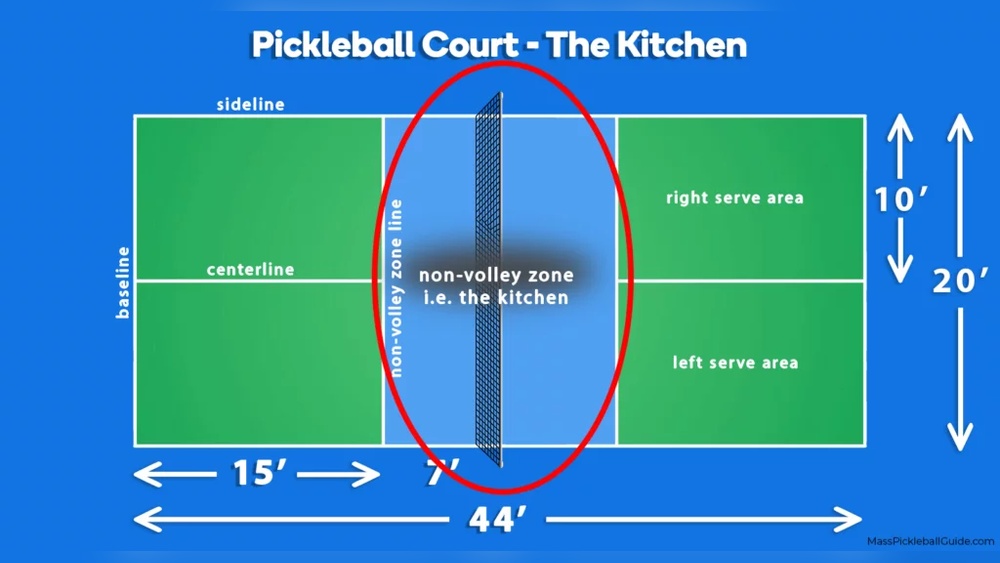
Before you can master the kitchen rules, you need to know what the kitchen is. In pickleball, the kitchen is the nickname for the non-volley zone. It’s a rectangular area measuring 7 feet from the net on both sides and stretches the width of the court.
This zone is marked clearly on every official pickleball court. The lines that define the kitchen are part of the kitchen itself. If any part of your foot touches these lines, you’re considered in the kitchen.
Why is it called the kitchen? The origin isn’t 100% clear, but the playful name helps players remember this is an area with special restrictions. It’s a place where certain actions are not allowed, making it a strategic part of the game.
The Non-volley Zone In Numbers
- Size: 7 feet from the net on each side
- Width: 20 feet (same as the court)
- Lines: Non-volley zone line (marks the kitchen boundary), sideline, and the net
The kitchen exists on both sides of the net, so all players must respect its rules, no matter which side they’re on.
The Purpose Of The Kitchen Rule
Many beginners wonder, “Why does the kitchen exist at all?” The main reason is to prevent players from dominating the net. Without this rule, tall or aggressive players could stand right at the net and slam every ball, making games short and less fun.
The kitchen rule creates a fair balance. It encourages rallies, clever placement, and soft shots called “dinks. ” By forcing players to stay out of the kitchen when volleying, it makes the game more skillful and less about brute force.
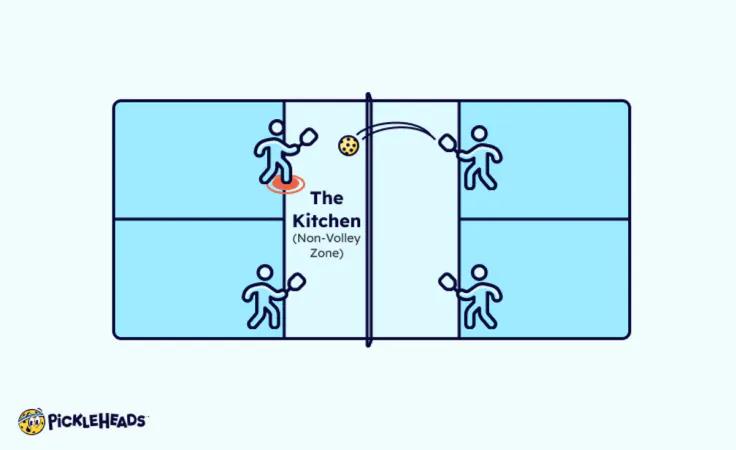
Credit: www.pickleheads.com
Can You Step Into The Kitchen In Pickleball?
This is the heart of the topic. The short answer: Yes, you can step into the kitchen, but not at any time and not for every shot.
Let’s break it down:
- You cannot volley (hit a ball out of the air) while standing in the kitchen or touching the kitchen lines.
- You can enter the kitchen to hit a ball that has bounced.
- After playing a volley, you cannot step into the kitchen or touch the kitchen lines—your momentum cannot carry you in.
- You can stand in the kitchen at any time except when volleying.
This rule is simple in writing, but in real play, it leads to many questions and mistakes. Below, we’ll explain each scenario in detail.
What Is A Volley In Pickleball?
Understanding the term volley is essential. In pickleball, a volley is hitting the ball before it bounces on your side. If the ball has bounced, any shot you make is not a volley.
Why does this matter? Because the kitchen rule only applies to volleys. You can step into the kitchen to play a ball that has bounced, but you cannot volley while in the kitchen or touching the kitchen lines.

Credit: www.justpaddles.com
Scenarios: When Can You Step Into The Kitchen?
Let’s get specific. Here are the main situations you’ll face and what the rules allow.
1. Hitting A Ball That Bounces In The Kitchen
If your opponent hits a soft shot or a dink and the ball lands in the kitchen, you can step into the kitchen to return it. Your feet can be in the kitchen, on the kitchen line, or even all the way up to the net—as long as the ball has bounced first.
2. Volleying Near The Kitchen
If you want to volley (hit the ball out of the air), your feet must be completely outside the kitchen and the kitchen lines. If any part of your foot is touching the kitchen line or inside the kitchen when you volley, it’s a fault.
3. Momentum After A Volley
If you volley a ball while outside the kitchen, but your momentum carries you into the kitchen (even after the ball is dead), it’s still a fault. The rule is strict: You must not touch the kitchen or kitchen lines as a result of your volley, even after the ball is gone.
4. Standing In The Kitchen During Play
You can stand in the kitchen at any time, but you can’t volley until both feet have left the kitchen and the lines. Some advanced players step into the kitchen to retrieve a drop shot, then quickly step back out so they’re ready for the next volley.
5. Serving And The Kitchen
The serve in pickleball must land beyond the kitchen on the opposite side. If the ball lands in the kitchen, it’s a fault. However, you as the server or receiver can stand anywhere on your own side (except in the kitchen for a volley).
Common Kitchen Rule Mistakes (and How To Avoid Them)
Many players—even experienced ones—make mistakes with the kitchen rule. Here are some of the most common and how you can avoid them:
- Touching the Kitchen Line on a Volley: Your shoes, even just the edge, can’t be on the line.
- Momentum Carrying You In: Even if you volley outside the kitchen, if your body falls into the kitchen afterward, it’s a fault.
- Reaching Over the Kitchen: Leaning over the kitchen to volley is allowed, as long as your feet don’t touch the kitchen or lines. But it’s easy to lose balance and step in.
- Not Re-establishing Both Feet: After being in the kitchen, you must have both feet completely outside the kitchen and lines before volleying again.
To avoid these mistakes, practice awareness of your foot position. Many players use the kitchen line as a reference and train themselves to stay just behind it for quick movement.
Why The Kitchen Rule Matters In Strategy
The kitchen rule isn’t just about avoiding faults—it’s a big part of pickleball strategy. Advanced players use the kitchen to control the pace of the game. Here’s how:
- Dinking: Players use soft shots into the kitchen, called dinks, to force opponents into awkward positions. Dinks slow the game and make it hard to attack.
- Third Shot Drop: On the third shot, players often hit a drop shot that lands in the kitchen. This brings both teams to the net for a strategic battle.
- Pressure at the Net: By pushing opponents near the kitchen line, you can force mistakes. But you must always be careful not to step in during a volley.
Understanding the kitchen helps you play smarter, not just harder.
Real-world Examples: How Kitchen Rule Plays Out
Let’s look at a few examples from real matches to see how the kitchen rule changes the game.
Example 1: The Classic Dink Rally
Both teams are at the net, dinking the ball softly into the kitchen. Each player steps into the kitchen to return balls that bounce, then steps back behind the line. This dance continues until someone makes a mistake or tries to volley a ball too close to the kitchen, resulting in a fault.
Example 2: The Over-eager Smash
A player rushes the net after a high ball and hits a volley, but their toe lands on the kitchen line. Even though they hit a great shot, it’s a fault because of the kitchen rule.
Example 3: The Momentum Mistake
A player volleys from just behind the kitchen but loses balance and falls forward, touching the kitchen with their paddle. The point goes to the other team because their momentum carried them into the kitchen after a volley.
These examples show how even small mistakes in footwork and awareness can cost you points.
Comparing The Kitchen Rule To Other Sports
The kitchen rule is unique to pickleball, but similar ideas exist in other sports. Here’s a quick comparison:
| Sport | Similar Rule | Purpose |
|---|---|---|
| Pickleball | Kitchen (Non-Volley Zone) | Prevents net domination, encourages rallies |
| Volleyball | Attack line (10-foot line) | Limits front-row attack, balances play |
| Tennis | No equivalent | Players can volley anywhere |
| Badminton | Short service line | Prevents smashes on serve |
Pickleball’s kitchen rule stands out for how it shapes rallies and player movement.
How To Practice Staying Out Of The Kitchen
Staying legal near the kitchen takes practice. Here are some drills and tips:
- Shadow Volleys: Stand behind the kitchen line and practice volleying imaginary balls. Focus on foot placement and balance.
- Footwork Drills: Use cones or tape to mark the kitchen. Practice stepping into the kitchen to retrieve a bounce, then quickly stepping back out.
- Partner Dinks: Work with a partner to dink the ball into each other’s kitchen. Each time, step in to retrieve the shot, then retreat.
- Use Cues: Some players say “kitchen” or “line” out loud to remind themselves where they are during fast rallies.
Practicing these habits will make staying out of the kitchen automatic in matches.
The Kitchen Rule And Doubles Vs. Singles Play
The kitchen rule applies in both singles and doubles pickleball. But the impact is a bit different:
- In doubles, players often play close to the kitchen line, making teamwork and communication key. Both players must be aware of their position.
- In singles, there’s more space to cover, so players may not approach the kitchen as often. Still, the rule is just as strict.
One non-obvious insight: In doubles, if your partner commits a kitchen fault (for example, by volleying with their foot on the line), it counts against your team—even if you were not involved in the shot.
What Happens If You Step In The Kitchen By Accident?
If you step into the kitchen or on the line during a volley, it’s called a fault. The other team wins the point or gets the serve, depending on the situation.
If you step in during a rally after a bounce, or before or after a shot that is not a volley, there is no penalty. The rule only applies during and after a volley.
One less-known detail: If you drop something (your hat, paddle, or even your sunglasses) into the kitchen during a volley, it still counts as a fault—even if your feet stay out.
The Kitchen And Advanced Tactics
Elite players use the kitchen rule for advanced tactics. Here are a few:
- Baiting Opponents: Some will hit high, slow balls near the kitchen, tempting opponents to step in for a smash—often causing a fault.
- Stacking: Doubles teams may use formations that put their strongest dinker near the kitchen, controlling the rally with precision.
- Fake Volleys: Faking a volley near the kitchen line can force errors or draw your opponent into the kitchen for a fault.
Knowing the kitchen rule lets you set traps and play smarter.
Official Rulebook: The Language Behind The Rule
The official rulebook from the USA Pickleball Association (USAPA) explains the kitchen rule in detail. The rule says:
- You cannot volley a ball while standing in the non-volley zone or touching the non-volley zone line.
- Your momentum from a volley cannot carry you into the non-volley zone.
- Any contact with the kitchen or line during a volley, or as a result of a volley, is a fault.
For the most recent rules, you can visit the USA Pickleball Official Rulebook.
Kitchen Rule: Data And Fault Statistics
How often do players fault because of the kitchen rule? In amateur tournaments, kitchen faults are one of the top three reasons for lost points, especially among newer players.
| Fault Type | Percentage of Total Faults (Amateur Level) |
|---|---|
| Kitchen Faults | 28% |
| Serve Faults | 35% |
| Double Bounce | 20% |
| Other | 17% |
This shows that mastering the kitchen rule can save you many points.
How The Kitchen Rule Has Evolved
The kitchen rule has changed a bit over time. Earlier versions were even stricter, with some confusion about whether momentum mattered. The current rules are clear: Momentum counts, and so does any contact with the kitchen during or after a volley.
One interesting change: In the past, players debated whether their paddle touching the kitchen was a fault. Now, any part of your body, paddle, or anything you’re wearing that lands in the kitchen after a volley is a fault.

Credit: rhinopickleball.com
Teaching The Kitchen Rule: Tips For New Players
If you teach pickleball or play with beginners, here’s how to explain the kitchen rule:
- Walk them to the kitchen line and point out the boundaries.
- Show examples—have them volley with feet behind the line, then step in after a bounce.
- Practice slow dinking rallies, stepping in and out of the kitchen.
- Explain that it’s better to lose a point by not volleying than to fault by stepping in.
Many beginners worry too much and avoid the kitchen altogether. Remind them: You can step in after a bounce! The key is to keep your feet out when volleying.
Myths And Misunderstandings About The Kitchen
Some common myths still confuse players:
- Myth: You can’t ever step in the kitchen.
Truth: You can step in after a bounce.
- Myth: Only feet count for faults.
Truth: Paddle, clothing, or dropped items also count.
- Myth: You can volley if you jump from behind the line and land in the kitchen.
Truth: If your momentum carries you in, it’s a fault—even if you were airborne.
Understanding these details sets you apart from casual players.
The Kitchen Rule In International Play
The kitchen rule is standard in all official pickleball competitions, including the International Federation of Pickleball. Whether you play in the US, Europe, or Asia, the rule is enforced the same way. Some local rules might have minor differences, but for tournaments, the kitchen is always 7 feet from the net, and volley restrictions are universal.
How To Appeal A Kitchen Fault
If there’s a dispute about a kitchen fault, here’s how it usually works:
- In friendly games, players call their own faults. Most disputes are settled with honesty.
- In tournaments, a referee will watch for kitchen faults and can overrule players.
- Video replay is rare but may be used in major tournaments.
The best defense is good awareness and clear communication with your partner.
Frequently Asked Questions
What Is The Kitchen In Pickleball?
The kitchen is the non-volley zone—a 7-foot area on both sides of the net. You cannot volley while standing in this area or touching its lines.
Can You Ever Step Into The Kitchen In Pickleball?
Yes, you can step into the kitchen at any time except when volleying. You can enter to play a ball that has bounced, but you must exit before volleying again.
What Happens If My Paddle Touches The Kitchen During A Volley?
If your paddle, body, or anything you wear touches the kitchen or its lines during or after a volley, it’s a fault and you lose the point or serve.
Can I Volley If I Jump From Outside The Kitchen And Land Inside?
No. If your momentum carries you into the kitchen after a volley, even if you were in the air, it’s a fault.
Is The Kitchen Rule The Same In Singles And Doubles?
Yes, the kitchen rule applies the same way in both singles and doubles. However, in doubles, communication and awareness are even more important.
Pickleball’s kitchen rule is more than just a line on the court—it’s a key part of the game’s balance and excitement. Learning when and how you can step into the kitchen will help you play smarter, avoid costly faults, and enjoy the game even more.
Whether you’re a beginner or aiming for competitive play, mastering the kitchen rule is a step toward becoming a true pickleball player.