
Pickleball has become one of the fastest-growing sports in the world, attracting players of all ages and skill levels. If you’re new to the game or looking to sharpen your understanding, one fundamental question often comes up: How do you score in pickleball? While the court may look similar to tennis or badminton, the rules for earning points in pickleball are unique. Knowing exactly how scoring works is not just about following the rules—it’s the key to improving your strategy, communicating with your partner, and enjoying the game to its fullest.
In this guide, you’ll learn the three official ways to score in pickleball, see practical examples, and understand the logic behind each method. You’ll also discover common mistakes, advanced tips, and useful comparisons to other racket sports. Whether you play singles, doubles, or are just starting, this article will help you master pickleball scoring—one of the most important parts of the game.
Understanding Pickleball Scoring Basics
Before diving into the three ways to score, it’s important to understand how pickleball scoring is structured. Unlike some other sports, only the serving side can score points. Games are usually played to 11 points (win by 2), but tournaments might use 15 or 21 points.
Key Scoring Features
- Only the serving team can score. If the receiving team wins the rally, they gain the serve, not a point.
- In doubles, both players on a team get a chance to serve before the serve switches.
- The score is called as three numbers in doubles: Server’s score, receiver’s score, server number (1 or 2).
- Singles use only two numbers: Server’s score and receiver’s score.
These rules are designed to keep games fair and balanced, rewarding consistency and good strategy rather than just lucky returns.
The 3 Ways To Score In Pickleball
Scoring in pickleball is straightforward once you know the three ways a point can be earned. Let’s break down each one, with examples and tips for practical play.
1. Scoring By Winning A Rally On Your Serve
The most common way to score in pickleball is to win a rally while your team is serving. This means the ball must be served legally, and your team must win the point before losing the serve.
How It Works
When your team is serving, you start the point. If the receiving team fails to return the ball within the rules—by hitting it into the net, out of bounds, or committing a fault—your team earns a point. The server continues to serve until a fault is made.
Example In Doubles
- Team A is serving, score is 5-3-1.
- Team A serves the ball, and Team B hits the return out of bounds.
- Team A scores a point, making it 6-3-1.
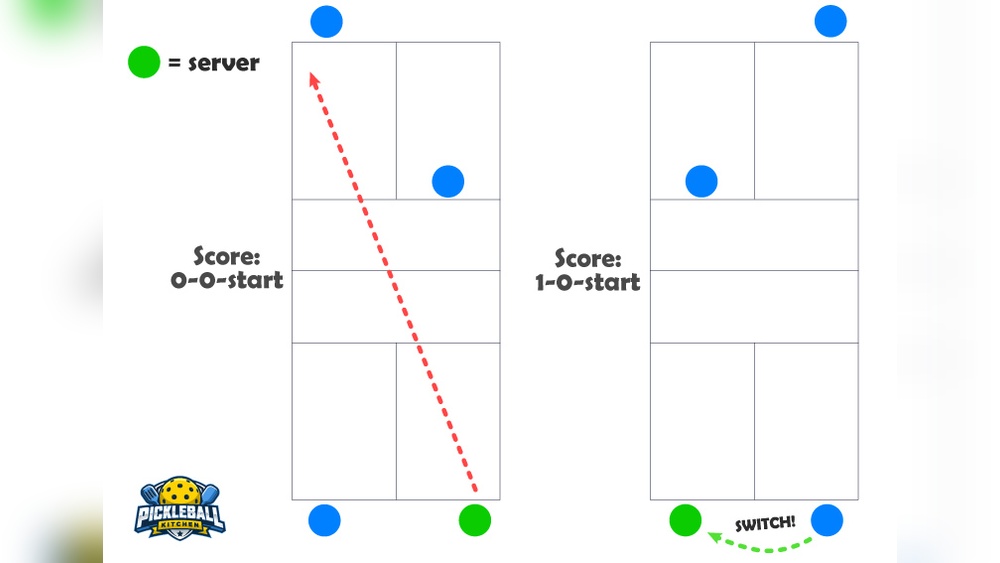
- The same server keeps serving from the opposite side.
Example In Singles
- Player 1 serves at 7-4.
- Player 2 returns the ball into the net.
- Player 1 scores, now it’s 8-4.
Key Points
- You can only score when serving. If you win a rally while receiving, you do not score a point; you gain the right to serve.
- Each serve is an opportunity. In doubles, both partners serve before the side out.
- No rally scoring. Unlike volleyball, pickleball does not allow the receiving side to score on a rally.
Non-obvious Insights
- Aggressive serving is not always best. Overpowering serves can lead to faults and lost chances to score. Placement and consistency matter more.
- The two-bounce rule creates scoring chances. Both sides must let the ball bounce once before volleys are allowed, giving the serving side a tactical advantage to set up points.
Common Mistakes
- Thinking you can score while receiving—this is not allowed.
- Forgetting to switch sides after a point in singles.
- Confusing the score announcement, especially in doubles.
2. Scoring By Opponent’s Fault On Your Serve
The second way to score is when the receiving team commits a fault while you are serving. While it may sound similar to winning a rally, this focuses on rules violations rather than just poor play.
What Counts As A Fault?
A fault is any action that breaks the official rules, such as:
- Hitting the ball out of bounds.
- Not clearing the net.
- Stepping into the non-volley zone (the “kitchen”) and volleying.
- Double-bouncing the ball.
- Failing to serve underhand or from the correct position.
- Serving before the receiver is ready.
If any of these happen while your team is serving, you immediately earn a point.
Examples
- You serve the ball, and your opponent volleys it before the required bounce. Point for you.
- The receiver’s return lands outside the baseline. Point for you.
- The receiver steps into the kitchen to hit a volley. Point for you.
Why This Is Important
Many beginners focus only on hitting winners, but understanding faults is crucial. You don’t always need to force a spectacular shot—sometimes, playing safe and consistent lets your opponent make the mistake.
Non-obvious Insights
- Smart play can force faults. Keeping the ball low, aiming for corners, or returning deep can increase the chance of opponent errors.
- Understanding the kitchen is vital. Many points are won when opponents violate non-volley zone rules, especially in fast exchanges.
Common Faults That Lead To Points
- Foot faults: Serving with a foot on the baseline.
- Illegal serves: Serving above the waist.
- Volleying in the kitchen: A frequent error at all levels.
Strategic Tip
In tight matches, experienced players sometimes play more conservatively while serving, knowing that many points come from opponent faults, not just aggressive play.
3. Scoring By A Technical Foul On The Opponent
The third way to score, though less common, is when the opponent is penalized with a technical foul during your serve. This is an official rule, used mainly in tournaments or organized play.
What Is A Technical Foul?
A technical foul is a penalty given by a referee for serious rule violations or unsportsmanlike behavior. Examples include:
- Arguing with officials or opponents.
- Deliberate distraction or interference.
- Repeated delay of game.
- Using illegal equipment after warning.
- Physical or verbal abuse.
When a technical foul is called against the receiving team during your serve, your team is awarded a point—even if the rally hasn’t started.
Example
- During a tournament, the receiver delays the game repeatedly after a warning.
- The referee issues a technical foul.
- The serving team is awarded a point.
Impact On Casual And Competitive Play
Technical fouls are rare in friendly games but more common in tournaments where referees enforce rules strictly. They remind players to maintain good sportsmanship and respect the game’s structure.
Non-obvious Insights
- Technical fouls can change momentum. A point awarded this way can break an opponent’s rhythm, especially in close games.
- Behavior matters. Even if you are not making physical mistakes, poor attitude or repeated rule-breaking can cost points.
Common Mistakes
- Not knowing the official tournament rules.
- Failing to warn teammates about possible technical violations.

Credit: www.pickleheads.com
Pickleball Scoring Compared To Other Racket Sports
Understanding how pickleball scoring differs from sports like tennis, badminton, or table tennis helps you avoid confusion and develop better strategies.
| Sport | Who Can Score | Game to (Points) | Unique Rule |
|---|---|---|---|
| Pickleball | Serving side only | 11, 15, or 21 (win by 2) | 2-bounce rule, kitchen |
| Tennis | Either side | 4 points per game, 6 games per set | No-volley zone is not present |
| Badminton | Either side (rally scoring) | 21 (win by 2) | Shuttle must land within lines |
| Table Tennis | Either side | 11 (win by 2) | Serve alternates every 2 points |
Pickleball’s unique scoring—only serving team scores—creates longer rallies and more strategic play. Some beginners, especially those with a tennis background, find this difference confusing at first.
Scorekeeping In Singles Vs. Doubles
Pickleball can be played as singles or doubles, and the way scores are called and tracked differs between the two. This can be a source of confusion, but once understood, it becomes second nature.
| Aspect | Singles | Doubles |
|---|---|---|
| Score Format | Server Score – Receiver Score | Server Score – Receiver Score – Server Number (1 or 2) |
| Serve Rotation | Switch sides after each point | Both players serve before side out |
| Who Can Score | Server only | Serving team only |
Practical Example In Doubles
If the score is 8-6-2, this means:
- The serving team has 8 points.
- The receiving team has 6 points.
- The second server is serving.
If the serving team wins the rally, the score becomes 9-6-2. If they lose, it’s “side out,” and the receiving team gains serve.
Common Beginner Mistake
Many new players forget to switch the server after a point or lose track of who is serving. Developing a habit of calling the score aloud before each serve helps maintain clarity and avoids disputes.

Credit: pickleballkitchen.com
Advanced Tips For Maximizing Your Scoring
To increase your chances of scoring, especially when serving, consider these expert strategies.
1. Serve Placement Over Power
Many beginners try to win points with strong, fast serves. However, well-placed serves—such as deep to the backhand or close to the sideline—are more likely to cause return errors or faults.
2. Use The Two-bounce Rule To Set Up Points
After the serve and return, both teams must let the ball bounce once. Use this moment to position yourself, anticipate the next shot, and set up an aggressive play or force the opponent wide.
3. Minimize Your Own Faults
The most common way to lose the serve is by committing avoidable errors: serving out, stepping into the kitchen, or not clearing the net. Practice consistency before power.
4. Communicate In Doubles
In doubles, clear communication about who will take the next shot prevents confusion and unnecessary faults.
5. Learn Opponent Tendencies
Watch how your opponents react to different serves or shots. Target their weaker side, and vary your placement to keep them guessing. This increases your chances of winning rallies and capitalizing on faults.
The Role Of Referees And Scoring In Tournaments
In official matches, referees keep track of the score and enforce rules for faults and technical fouls. They also resolve disputes about scoring, server positions, and foot faults. In recreational play, players must self-officiate, so honesty and sportsmanship are crucial.
If you plan to play in tournaments, read the official rulebook and understand how technical fouls and timeouts affect scoring. For more details, the official USA Pickleball Rulebook is a trusted resource: USA Pickleball Rulebook.
Why Scoring Rules Make Pickleball Unique
Pickleball’s scoring system is designed to reward both skill and strategy. By allowing only the serving team to score, games tend to be longer and more tactical. Players must be patient, consistent, and strategic to earn points, and every serve becomes important.
Beginners often focus only on winning rallies, but experienced players know that understanding faults, technical fouls, and the subtle differences between singles and doubles is what separates average from great players.
Frequently Asked Questions
What Happens If The Wrong Score Is Called Before Serving In Pickleball?
If the wrong score is called, the server should stop and correct it before serving. If the ball is served with the wrong score called and play continues, the point stands unless the mistake is noticed before the next serve.
In tournaments, referees will help correct the score, but in casual play, it’s up to players to agree.
Can The Receiving Team Ever Score A Point In Pickleball?
No, the receiving team cannot score a point. Only the serving side can win points. If the receiving team wins the rally, they gain the right to serve but do not receive a point.
What Is A Side Out In Pickleball?
A “side out” occurs when the serving team loses their serve(s), and the serve goes to the opposing team. In doubles, both partners must lose their serve before a side out happens. This rule keeps the game balanced and gives both teams a fair chance to score.
How Do You Know Who Serves First In Pickleball?
At the start of a game, teams usually decide who serves first by a coin toss or another random method. In doubles, the first serve is always from the right-hand side, and only the first server gets to serve in the opening rotation before a side out.
Are There Any Exceptions To The Scoring Rules In Tournaments?
Some tournaments may use rally scoring (where either team can score on any rally) for faster play, but this is rare. Most official matches use traditional scoring. Always check the tournament rules before playing, as local variations can exist.
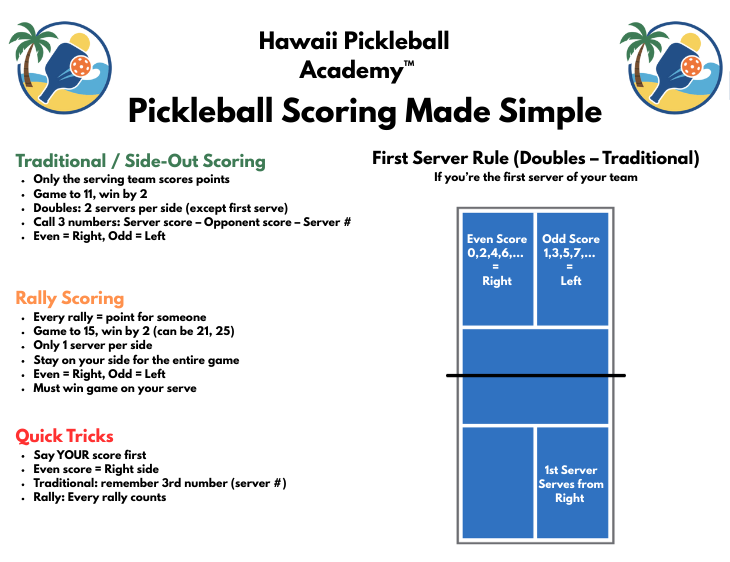
Credit: hawaiipickleball.com
Final Thoughts
Mastering the three ways to score in pickleball is essential for anyone who wants to improve and enjoy the game. By focusing on winning rallies while serving, understanding how opponent faults and technical fouls award points, and learning the nuances of singles versus doubles, you will play smarter and more confidently. Remember, pickleball’s unique scoring makes every serve an opportunity—and every point earned is a testament to your skill, strategy, and sportsmanship. Whether you’re playing for fun or aiming for trophies, knowing how to score is your ticket to success on the court.