
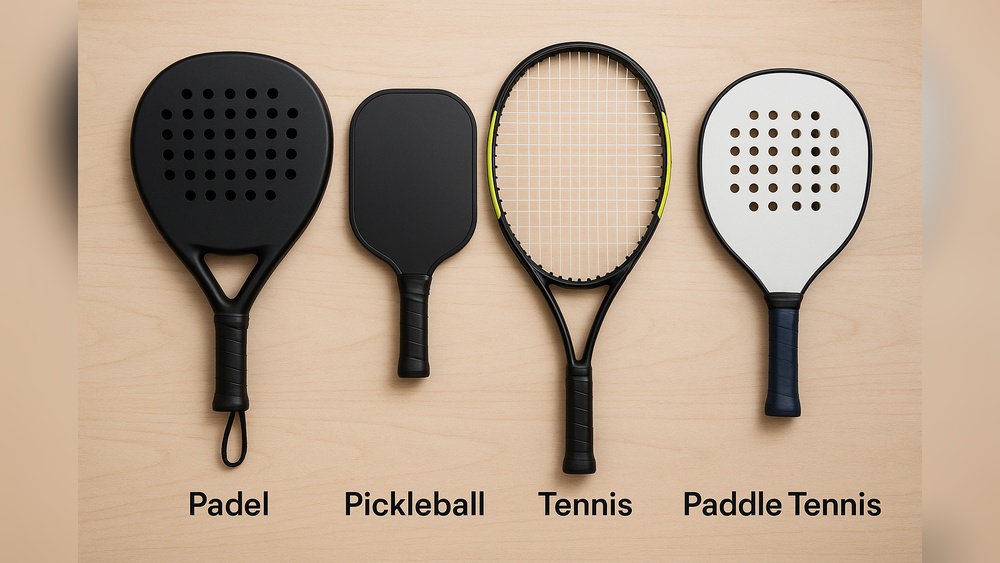
Padel, pickleball, and squash are fast-growing racket sports that attract people of all ages. Each offers unique excitement, strategies, and physical challenges. For beginners or anyone curious about these sports, the differences can be confusing. Some think padel and pickleball are almost the same.
Others wonder if squash is just an older, indoor version. But the truth is, each sport has its own rules, equipment, court, and playing style.
Understanding these differences is important before you pick up a racket—or paddle—and step onto the court. Maybe you want to find a sport that matches your fitness level, or maybe you’re searching for something social and easy to start. In this article, you’ll discover exactly how padel, pickleball, and squash compare. We’ll look at history, court design, equipment, rules, playing experience, and even the culture around each sport. With clear explanations, examples, and real data, you’ll know which one fits your goals and personality.
Origins And History
To understand why padel, pickleball, and squash are so different, it helps to know where they came from and how they evolved.
Padel
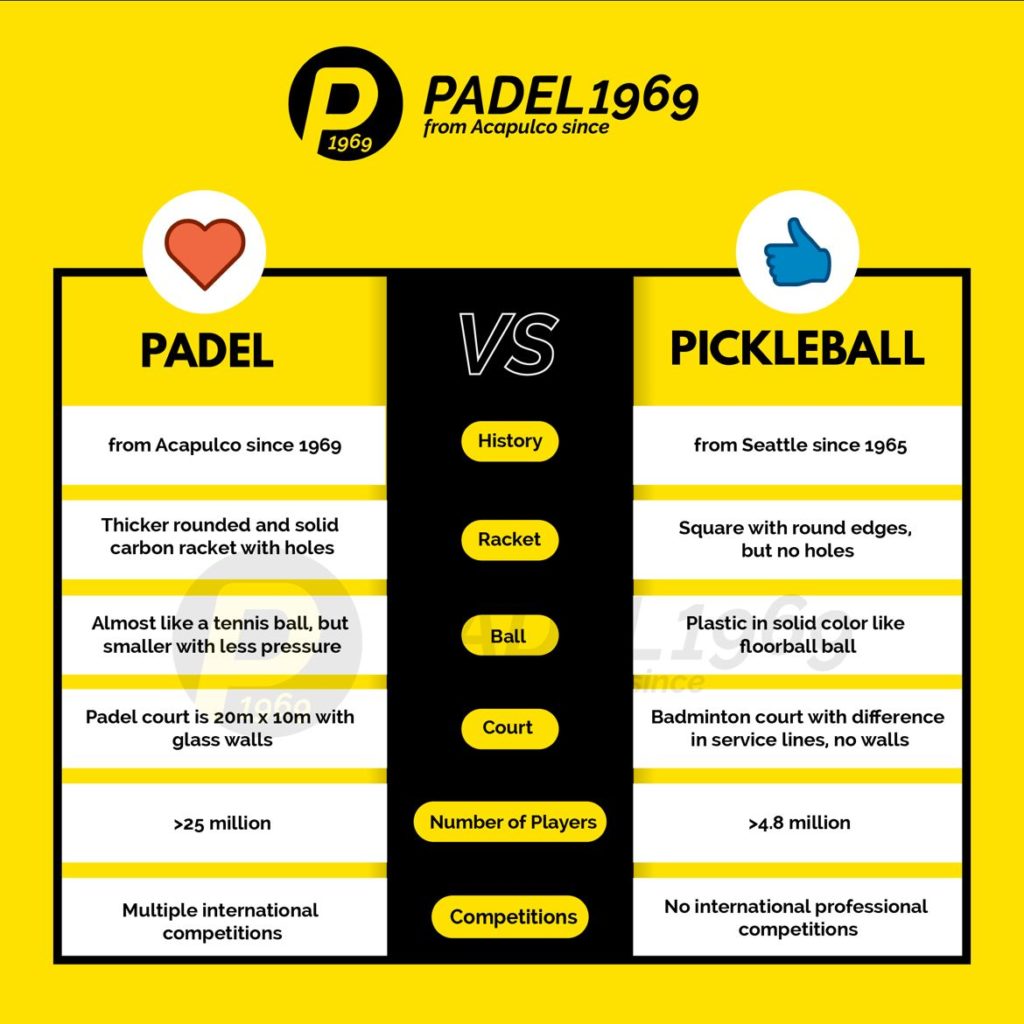
Padel started in Mexico in 1969. Enrique Corcuera, a businessman, wanted a fun backyard game for family and friends. He mixed rules from tennis and squash but made the court smaller, with glass walls. The sport spread quickly to Spain and Argentina, becoming a favorite for group play. Today, Spain has over 20,000 padel courts, and it’s the country’s second most popular sport after soccer.
Pickleball
Pickleball’s story began in Washington state, USA, in 1965. Three dads—Joel Pritchard, Bill Bell, and Barney McCallum—created a backyard game for their bored kids. They used ping-pong paddles, a plastic ball, and a badminton court. The result was a sport that combined tennis, badminton, and table tennis. Pickleball is now the fastest-growing sport in the US, with over 8 million players as of 2023.
Squash
Squash is the oldest of the three. It started in the United Kingdom around 1830, at Harrow School. Students changed the rules of an older game called rackets by using a soft rubber ball. The ball “squashed” against the walls, making rallies longer and more strategic. Squash spread to British colonies and later around the world. There are now more than 20 million squash players globally.
Court And Playing Area
The court is where you first see big differences between these sports. Size, surface, and wall use all affect gameplay.
Padel Court
A standard padel court is 20 meters long and 10 meters wide—smaller than a tennis court. The court is surrounded by glass and wire mesh walls. Players use these walls during play, similar to squash. The surface is usually artificial turf with sand infill, which gives consistent ball bounce and reduces injury risk. Padel is always played as doubles (2 vs 2), and the court is divided by a net, just like tennis.
Pickleball Court
A pickleball court is much smaller—13.4 meters long and 6.1 meters wide. The surface is usually hard (concrete or asphalt), similar to a tennis court. There are no walls. The most unique part is the “kitchen”—a 2.13-meter area near the net where volleying is not allowed. Pickleball can be played as singles or doubles.
Squash Court
A squash court is indoors and box-shaped. It measures 9.75 meters long and 6.4 meters wide, with walls on all sides and a high ceiling. The front wall has a large playing area, and the back wall is lower. The floor is wood or synthetic. Squash is almost always played as singles, but doubles courts are available in some countries.
Here’s a side-by-side court size comparison:
| Sport | Length (m) | Width (m) | Walls? | Surface |
|---|---|---|---|---|
| Padel | 20 | 10 | Glass & wire mesh | Artificial turf |
| Pickleball | 13.4 | 6.1 | No | Hard (concrete/asphalt) |
| Squash | 9.75 | 6.4 | Yes (all sides) | Wood/synthetic |

Credit: pickleballunion.com
Equipment
Each sport uses different rackets, balls, and shoes. The equipment changes the feel and style of the game.
Padel Equipment
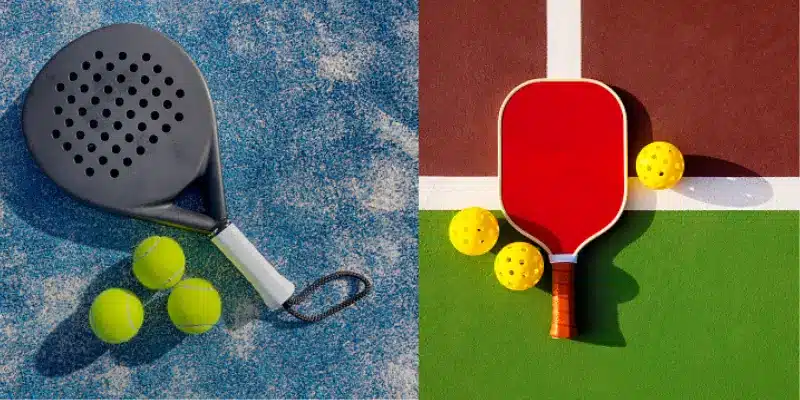
- Racket: Padel rackets are solid, perforated, and made of composite materials. They have no strings. Standard size is about 45.5 cm long and 26 cm wide. Weight ranges from 340 to 390 grams.
- Ball: Looks like a tennis ball but with slightly less pressure, so it bounces lower.
- Shoes: Must have good grip for artificial turf.
Pickleball Equipment
- Paddle: Pickleball paddles are solid, rectangular, and often made of lightweight materials like graphite or carbon fiber. They are about 40 cm long and 20 cm wide. Weight is usually 200-250 grams.
- Ball: A plastic ball with holes (like a wiffle ball), 7.3 to 7.6 cm in diameter. Indoor and outdoor balls are different—outdoor balls are heavier and have smaller holes.
- Shoes: Similar to tennis or badminton shoes, designed for lateral movement.
Squash Equipment
- Racket: Squash rackets are long, with strings and an oval head. They are about 68.5 cm long, weighing 110 to 170 grams.
- Ball: Made of rubber, smaller than a golf ball (about 4 cm in diameter). The ball barely bounces until warmed up by play.
- Shoes: Non-marking soles required to protect the court surface.
Here’s a quick comparison of racket/paddle size and weight:
| Sport | Racket/Paddle Size (cm) | Weight (g) | Has Strings? |
|---|---|---|---|
| Padel | 45.5 x 26 | 340–390 | No |
| Pickleball | 40 x 20 | 200–250 | No |
| Squash | 68.5 (length) | 110–170 | Yes |
Rules And Scoring
Rules shape how each sport is played. Let’s break down the basics and spot the main differences.
Padel Rules
- Players: Always doubles (2 per team)
- Serve: Underhand, must bounce behind the service line and land diagonally. Serve must go below waist height.
- Walls: Ball can bounce off any wall after hitting the ground. Players use the walls to extend rallies and create angles.
- Scoring: Same as tennis (15, 30, 40, deuce, advantage, game). Best of 3 or 5 sets.
- Unique twist: If the ball leaves the court after bouncing, a player can run outside and return it, as long as it doesn’t bounce twice.
Pickleball Rules
- Players: Singles (1 vs 1) or doubles (2 vs 2)
- Serve: Underhand from behind baseline, ball must clear the non-volley zone (“kitchen”). Only one serve attempt is allowed.
- Kitchen: Players can’t volley (hit out of the air) in this zone, which encourages rallies and reduces smash shots.
- Scoring: Games go to 11 points, win by 2. Only the serving side scores points.
- Double bounce rule: After the serve, the ball must bounce once on each side before volleys are allowed.
Squash Rules
- Players: Singles (most common) or doubles
- Serve: Hit above the service line on the front wall, landing in the opposite back quarter of the court.
- Walls: Every wall is in play. Shots can rebound off side and back walls before hitting the front wall.
- Scoring: Modern squash uses “point-a-rally” scoring to 11. Win by 2 points.
- Let and stroke: If players block each other, a “let” (replay) or “stroke” (point awarded) is given based on safety and fairness.
Playing Style And Experience
What is it actually like to play each sport? Here’s how the action feels, plus what makes each one unique.
Padel: Strategy And Teamwork
Padel is fast but less physically demanding than squash. The enclosed court and glass walls keep the ball in play longer. Rallies often last 10–15 shots, and teamwork is key. Players use smart positioning, soft shots, and clever lobs. It’s less about power, more about tactics and communication.
A non-obvious insight: beginners often focus too much on hitting hard. In padel, controlling the ball and using the walls is more important. Learning to “reset” a point with a lob or soft shot often wins matches.
Pickleball: Quick Reflexes And Social Fun
Pickleball moves at a medium pace. The plastic ball slows the game a bit, but the smaller court means fast footwork is needed. The “kitchen” rule creates funny, close-up battles at the net. It’s very social and easy to learn, so people of all ages can play together.
A common mistake: beginners often stand too far back. The best players stay near the kitchen line, ready to volley. Dinks—soft, short shots—are a big part of winning strategy.
Squash: Intense And Physical
Squash is high-intensity, with the ball moving over 200 km/h in pro matches. Because the ball is slow until it warms up, rallies can be long and tiring. Players need stamina, agility, and fast reactions. The walls allow for creative shots—like “boasts” (side wall first) and “drops” (soft front shots).
Many new players make the error of chasing the ball instead of returning to the “T” (center court). Controlling the center makes it easier to reach all shots.
Fitness And Health Benefits
All three sports offer great exercise, but each has different fitness benefits.
Padel
Padel is moderate-intensity. It’s easier on the knees and joints than squash because of the artificial turf and slower pace. You get a mix of aerobic exercise and bursts of speed. Playing doubles means less running, but teamwork builds communication and coordination.
Pickleball
Pickleball is gentle on the body. The court is small, and the plastic ball doesn’t move as fast as a tennis or squash ball. It’s excellent for older adults or those returning from injury. It still offers good cardio, quick reflex training, and improves balance.
Squash
Squash is one of the toughest sports for fitness. According to Forbes, squash burns up to 800–1000 calories per hour. It builds endurance, leg strength, core stability, and agility. However, it’s also demanding on joints and requires good warm-up and cool-down routines to avoid injury.
Here’s a comparison of calories burned per hour (for a 70 kg person):
| Sport | Calories Burned (per hour) | Intensity Level |
|---|---|---|
| Padel | 400–600 | Moderate |
| Pickleball | 350–500 | Low to Moderate |
| Squash | 800–1000 | High |
Popularity And Growth
Popularity depends on country, culture, and even weather. Let’s see where each sport is growing fastest.
Padel’s Global Boom
Padel has exploded in Spain, where over 5 million people play. It’s also growing quickly in Italy, Sweden, France, and the Middle East. New courts are opening worldwide, and the World Padel Tour draws big crowds. Many tennis clubs are adding padel courts to attract younger members.
Pickleball’s U.s. Dominance
In the United States, pickleball is the fastest-growing sport, with participation rising nearly 40% from 2021 to 2023. Schools, retirement communities, and parks are adding courts. It’s also spreading to Canada, Australia, and Asia. The sport’s low cost and easy learning curve help its popularity.
Squash’s Steady Base
Squash remains strong in the UK, Egypt, Pakistan, and Australia. Egypt produces most of the world’s top professional players. While squash isn’t growing as fast as padel or pickleball, it has a loyal global community. Many universities offer squash scholarships.
Skill Levels And Learning Curve
How hard is it to learn each sport? What does it take to become competitive?
Padel: Easy To Start, Deep To Master
Padel is beginner-friendly. The smaller court, slower ball, and use of walls make rallies last longer. New players can have fun quickly. However, mastering wall shots and tactics takes time. Advanced players use clever angles, team formations, and “bandejas” (overhead shots).
Pickleball: Quick Progress
Pickleball is famous for its easy learning curve. Most people can play a game within 30 minutes of first picking up a paddle. The rules are simple, and the ball moves slower than in tennis or squash. There’s still plenty of room for skill—top players use spin, dinks, and fast reactions.
Squash: Fast And Demanding
Squash is the hardest to learn of the three. The ball is small, and its bounce changes as it warms up. Players must move quickly and control their shots with accuracy. Beginners often find rallies short at first, but as skills improve, games become longer and more strategic.
Credit: padel1969.com
Social Aspects And Community
The atmosphere and culture around each sport add to their appeal.
Padel: Social And Inclusive
Padel is almost always doubles, so it’s naturally social. Clubs often organize group play, beginner lessons, and tournaments. The sport is popular with young adults and families. Many clubs have a relaxed, friendly vibe.
Pickleball: Welcoming For All Ages
Pickleball attracts children, adults, and seniors alike. Most clubs encourage “drop-in” play, where players mix and match partners. The community is known for being supportive and inclusive. Players often socialize before and after games.
Squash: Competitive But Friendly
Squash has a more traditional club culture. While it can be very competitive at higher levels, most clubs welcome all skill levels. Squash ladders and leagues give beginners a way to improve and meet new people. Some clubs host social events and fitness classes.
Cost And Accessibility
Trying a new sport can be expensive or cheap, depending on the gear, court fees, and availability.
Padel
- Equipment cost: A basic padel racket costs $50–$150. Balls are about $5 per can.
- Court fees: $10–$20 per person for 60–90 minutes.
- Court availability: Growing fast, but limited in some countries.
Pickleball
- Equipment cost: Paddles start at $20–$100. Balls are $2–$3 each.
- Court fees: Many public courts are free; private clubs may charge $5–$10.
- Court availability: Very good in the US and Canada, expanding globally.
Squash
- Equipment cost: Rackets start at $40–$200. Balls are $3–$5 each.
- Court fees: $10–$25 per hour, but many clubs offer memberships.
- Court availability: Good in cities, less so in rural areas.
A non-obvious insight: both padel and pickleball can be played outdoors, which keeps costs down and makes play more flexible. Squash is almost always indoors, so it’s less affected by weather but requires special facilities.
Credit: jeangalea.com
Injuries And Safety
All racket sports have injury risks, but some are safer than others.
Padel
Padel’s artificial turf and slower pace reduce impact injuries. Most common injuries are sprains, tennis elbow, and shoulder soreness. Warming up and stretching help prevent problems.
Pickleball
Pickleball is low-impact but still causes ankle sprains, knee pain, and paddle-related wrist injuries. Proper shoes and good technique are important. Older adults should pay attention to balance.
Squash
Squash’s speed and close quarters mean more risk. Ankle twists, muscle strains, and even eye injuries (from the fast ball) are possible. Goggles are recommended for safety.
Which Sport Should You Choose?
Your best choice depends on your goals, fitness, and what’s available nearby.
- Choose padel if you like teamwork, strategy, and social play. It’s good for all ages and fitness levels.
- Choose pickleball if you want a gentle workout, quick learning, and a fun community. It’s ideal for mixed-age groups.
- Choose squash if you want an intense workout, fast action, and don’t mind a steeper learning curve. It’s perfect for those who love a physical challenge.
Trying each sport at a local club or open day is the best way to decide.
Frequently Asked Questions
What Is The Main Difference Between Padel, Pickleball, And Squash?
The main difference is the court and wall use. Padel and squash use walls for play; pickleball does not. Padel uses a glass enclosure and is always doubles. Pickleball has a small, open court with a “kitchen” zone. Squash is played inside a four-walled room with a small rubber ball.
Which Sport Is Easiest For Beginners?
Pickleball is the easiest for beginners. The rules are simple, the court is small, and the ball moves slower. Most people can start playing and enjoy rallies within their first session.
Is Padel More Popular Than Squash?
In some countries like Spain and Argentina, padel is now more popular than squash. But worldwide, squash still has a larger base, especially in the UK, Egypt, and Asia. Padel is growing fast and may soon catch up.
Can I Play These Sports If I Have Joint Problems?
Pickleball and padel are gentler on the joints compared to squash. The surfaces are softer, and the movement is less intense. Always consult with a doctor before starting a new sport, especially if you have past injuries.
Where Can I Find Official Rules For Each Sport?
You can find official rules on the websites of the International Padel Federation, USA Pickleball Association, and World Squash Federation. For example, see the Wikipedia Pickleball page for a detailed overview.
Padel, pickleball, and squash each have unique features, challenges, and communities. Whether you want a social, strategic, or high-intensity game, there’s a racket sport that fits your style. Give each one a try—you may discover a new passion and a welcoming community.