
Pickleball is a fast-growing sport that combines elements from tennis, badminton, and ping pong. You may have seen people playing in parks, community centers, or even on converted tennis courts. But if you’re new to the game, one question probably comes up quickly: What are pickleballs made of? The small, plastic ball is central to the sport, affecting everything from how the game feels to how it is played. The material, design, and even how pickleballs are produced all matter more than most beginners realize.
Understanding what goes into making a pickleball is not just for equipment nerds. The ball’s construction influences its bounce, speed, durability, and even the sound it makes. If you want to play well or choose the right equipment, you need to know these details. In this article, you’ll learn exactly what pickleballs are made of, why those materials are used, how manufacturing works, and how different balls compare for indoor and outdoor play. You’ll also discover some practical tips that even many regular players miss.
The Core Material: Polyethylene And Its Role
At the heart of nearly every pickleball is polyethylene. This is a type of plastic known for being lightweight, durable, and flexible. Polyethylene comes in a few forms, but for pickleballs, manufacturers usually use high-density polyethylene (HDPE) or sometimes low-density polyethylene (LDPE). These plastics are chosen for a reason: they strike a balance between toughness and the right amount of flexibility.
HDPE is valued because it resists cracking, even when hit hard or used outdoors in rough conditions. LDPE, on the other hand, is a bit softer and more flexible, which can be helpful for indoor balls that need a bit more “give.” Some companies blend both types to get the best of both worlds.
Polyethylene has a few key benefits:
- Lightweight: Makes the ball easy to hit and control.
- Durable: Handles the stress of repeated impacts.
- Resistant to weather: Doesn’t absorb water or warp in the sun.
One non-obvious fact is that the exact mix of plastic can change the ball’s playability in subtle ways. Even a small shift in density or additives can make a ball bounce higher or fly faster, which matters for players at all skill levels.
How Pickleballs Are Manufactured
The process of making a pickleball is more involved than it looks. Most pickleballs are produced using a method called injection molding. Here’s a simplified explanation:
- Polyethylene pellets are melted down until they become a liquid.
- This liquid plastic is injected into a spherical mold.
- The mold is pressed together under high pressure, forming a hollow ball.
- After cooling, the ball is removed and trimmed to remove any rough edges.
- Holes are drilled or punched into the ball in a precise pattern.
- The ball is cleaned, tested, and sometimes polished.
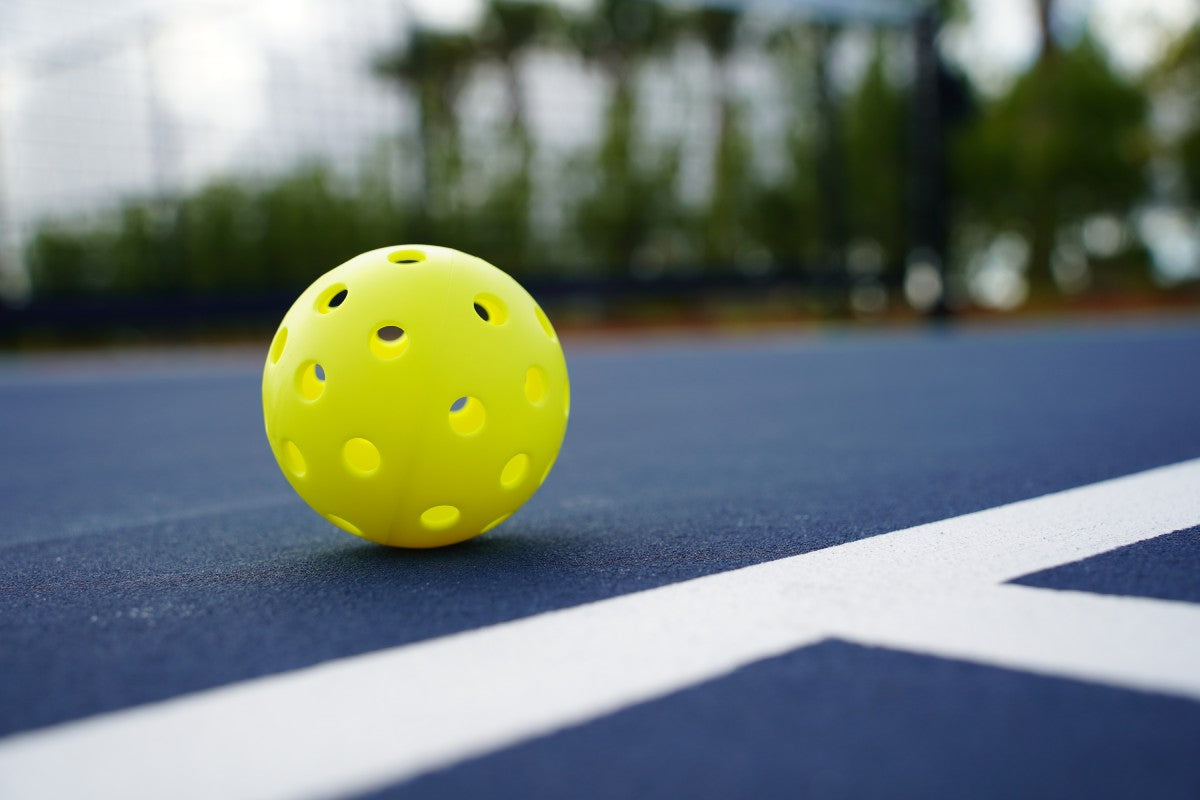
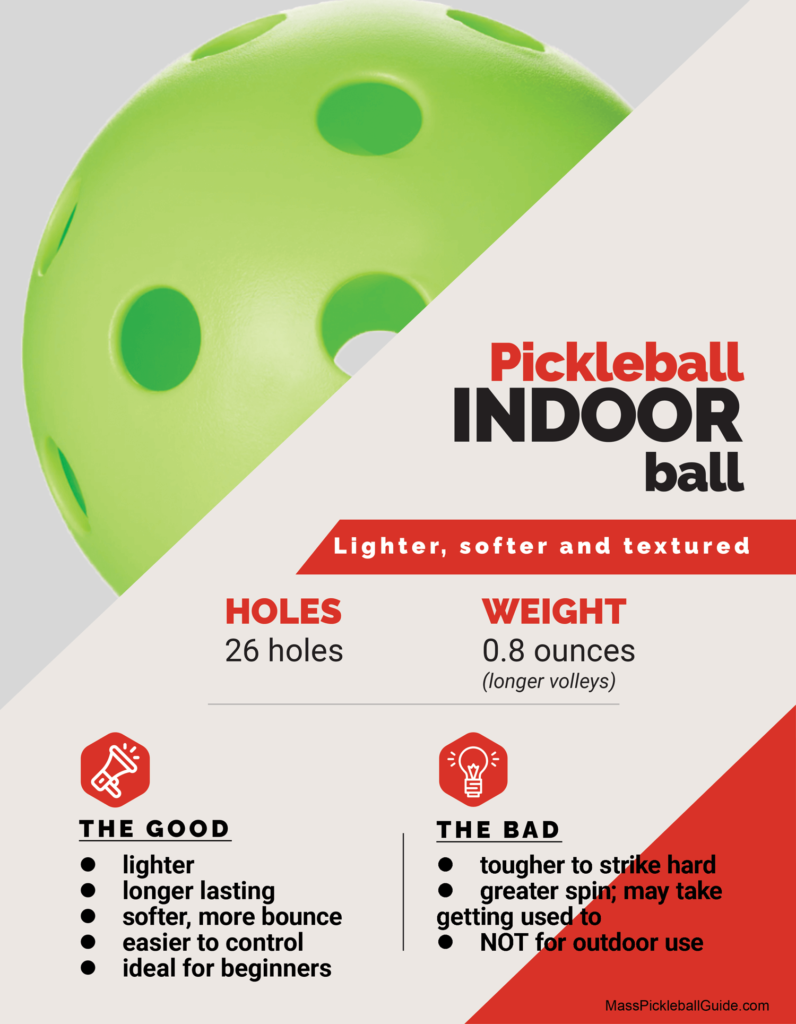
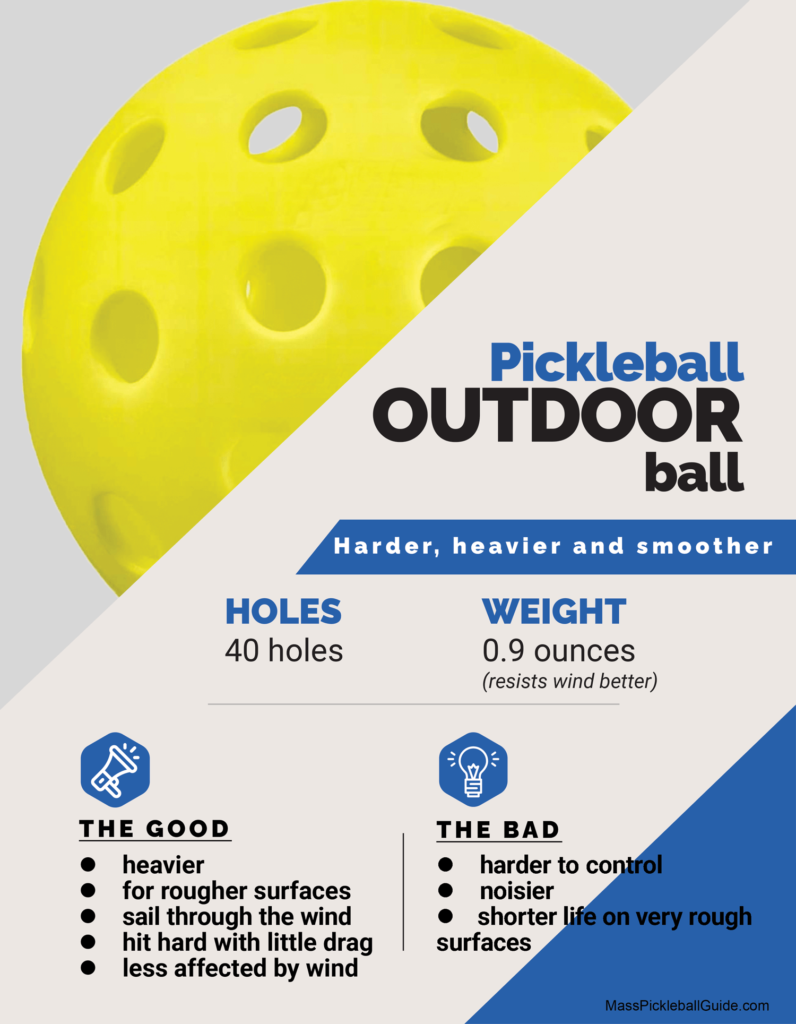
The holes are a critical part of the process. Outdoor balls usually have 40 smaller holes to reduce wind effects, while indoor balls have fewer (often 26) but larger holes to give a slower, more controlled bounce.
It’s important to note that some cheaper pickleballs use a two-piece construction. They mold two halves separately and then fuse them together. Higher-quality balls are often one-piece, making them more consistent and less likely to split.
Credit: pickleballsuperstore.com
Why Pickleballs Use Plastic Instead Of Other Materials
Why don’t manufacturers use rubber, wood, or even metal? The answer is a mix of weight, safety, cost, and performance.
- Rubber would be too bouncy and heavy, making games uncontrollable.
- Wood is too heavy and could splinter, creating safety issues.
- Metal would be dangerous and damage paddles or courts.
- Plastic offers the ideal combination of lightweight feel, bounce, and safety.
Another subtle reason is that plastic can be recycled. Some brands are experimenting with recycled polyethylene, which helps reduce environmental impact. However, the main priority is always performance.
The Differences Between Indoor And Outdoor Pickleballs
Not all pickleballs are the same. The material is similar, but the design and production are different for indoor and outdoor balls. Here’s how they compare:
| Feature | Indoor Pickleballs | Outdoor Pickleballs |
|---|---|---|
| Number of Holes | 26 (larger) | 40 (smaller) |
| Plastic Type | Softer LDPE blend | Harder HDPE blend |
| Durability | Less durable | More durable |
| Bounce | Softer, higher | Lower, faster |
| Noise | Quieter | Louder |
Indoor pickleballs are designed for smooth surfaces like gym floors. They are a bit softer and have larger holes, so they don’t bounce as quickly or unpredictably. Outdoor pickleballs, in contrast, use a harder plastic with more, smaller holes. This helps them resist the wind and last longer, even when played on rougher surfaces like asphalt or concrete.
A beginner might not notice the difference right away, but experienced players can tell instantly. Using the wrong ball for the wrong surface can lead to a frustrating game.
Credit: masspickleballguide.com
The Role Of Additives And Colorants
Pickleballs aren’t just plain plastic. Manufacturers add a variety of additives and colorants to improve performance and appearance.
Additives
- UV stabilizers: These chemicals protect the ball from breaking down in sunlight, which is essential for outdoor play.
- Impact modifiers: Improve the ball’s ability to withstand hard hits without cracking.
- Antistatic agents: Help stop dust from sticking to the ball, especially important for indoor play.
Colorants
Most pickleballs come in bright colors like yellow, orange, green, and white. These colors aren’t just for looks. High-visibility colors make it easier for players to track the ball against different backgrounds and in varying light conditions.
There’s a trade-off: darker colors can fade faster in sunlight, while lighter colors can get dirty quickly. Manufacturers try to find a balance, and that’s why yellow is the most common color—it’s visible but also durable.
How Pickleball Material Affects Play
The type of plastic and the manufacturing process directly affect how a pickleball behaves during a game. Here’s what you should know:
- Hardness: Harder balls bounce lower and move faster. This is preferred for outdoor play, where wind and rough surfaces can slow the ball.
- Flexibility: Softer balls can provide a little more control, which is helpful indoors.
- Weight: The official weight range is 0.78 to 0.935 ounces (22.1 to 26.5 grams). Even small differences can change how the ball feels on the paddle.
- Surface texture: A smoother ball is faster, while a slightly textured ball may be easier to spin.
Manufacturers test every batch for roundness, weight, and bounce. Any ball that doesn’t meet standards is rejected. This is one reason why official tournament balls cost more—they have tighter quality control.
Here’s a data table comparing popular ball brands and their material choices:
| Brand | Material | Indoor/Outdoor | Construction |
|---|---|---|---|
| Dura Fast 40 | HDPE | Outdoor | One-piece |
| Onix Fuse G2 | LDPE/HDPE blend | Indoor/Outdoor | Two-piece fused |
| Franklin X-40 | HDPE | Outdoor | One-piece |
| Jugs Indoor | LDPE | Indoor | One-piece |
Notice that top brands stick with HDPE for outdoor balls due to its strength and weather resistance. For indoor play, a softer LDPE is more common for better feel.
Credit: masspickleballguide.com
Official Standards For Pickleball Materials
The USA Pickleball Association (USAPA) sets the official rules for ball construction. To be “tournament-approved,” a ball must:
- Be made of a durable, smooth plastic.
- Be a uniform color.
- Weigh between 0.78 and 0.935 ounces (22.1 – 26.5 grams).
- Have a diameter between 2.87 and 2.97 inches (73 – 75.5 mm).
- Bounce between 30 and 34 inches (76 – 86 cm) when dropped from 78 inches.
- Have between 26 and 40 round holes.
Balls are tested for compression strength and roundness, using machines to ensure consistency. Even a small defect can make a ball wobble, which is not allowed in sanctioned matches.
Non-obvious insight: Tournament balls often have a “breaking-in” period. They may feel harder and less bouncy right out of the package, but after a few games, they settle into their ideal playing condition. Some players “season” new balls before an important match.
Durability And Lifespan Of Pickleballs
How long does a pickleball last? It depends on the material, how and where you play, and the quality of manufacturing.
- Outdoor balls: Last between 3 to 10 games before they become cracked or lose their bounce. Sunlight and rough courts shorten their life.
- Indoor balls: Can last up to 20 games or more, since gym floors are less abrasive and there’s no UV exposure.
You’ll know a ball is worn out if:
- It develops cracks.
- It becomes misshapen (egg-shaped).
- It sounds “dull” when hit.
- It doesn’t bounce to the same height as before.
A tip that many beginners miss: Rotate your balls regularly. Don’t play with the same ball until it breaks. Mixing in fresh balls during practice helps you adjust to minor variations in play and extends the lifespan of your entire set.
Environmental Concerns And Advances
Plastic sports equipment raises concerns about environmental impact. While pickleballs are not single-use, they do wear out. Most balls are not biodegradable, but they can be recycled if local facilities accept HDPE or LDPE plastics.
Some companies are now experimenting with:
- Recycled plastics: Using post-consumer or post-industrial plastic in their balls.
- Biodegradable additives: Trying to make balls that will break down more quickly in landfills.
- Take-back programs: Collecting used balls to be ground down and reused.
This area is evolving. If you’re environmentally conscious, look for brands that mention recycled content or eco-friendly practices. However, performance is still the main concern for most players.
For more about plastic recycling and sports equipment, see this Wikipedia article on HDPE.
The Impact Of Ball Material On Game Strategy
Many new players don’t realize how much the ball’s material affects strategy. A harder, faster ball (like those used outdoors) favors aggressive play and quick volleys. A softer indoor ball allows for longer rallies and more controlled shots.
Experienced players will sometimes “test” different brands or batches to find the ball that matches their style. For example, if you like dinking (soft shots near the net), a softer, slightly textured ball might give you more control. If you prefer power shots, a harder ball will move faster and react more predictably.
Another advanced tip: Altitude and temperature change how the ball feels. At higher altitudes or in hot weather, balls bounce higher and fly faster, so some tournament players bring several types of balls to adjust for conditions.
Common Mistakes When Choosing A Pickleball
- Using the wrong type for the surface: Don’t use indoor balls outside, or vice versa. They wear out quickly and play poorly.
- Ignoring color: If you play in a gym with light floors, a yellow ball may be hard to see. Choose a color with strong contrast.
- Buying the cheapest balls: Bargain balls often crack or warp quickly, costing more in the long run.
- Not checking for approval: If you plan to play in tournaments, make sure your balls are USAPA approved.
- Forgetting personal preference: Try a few brands and see which feels best for your style.
Innovations In Pickleball Materials
The basic recipe—polyethylene plastic—has not changed much in decades, but manufacturers are always looking for small improvements. Recent innovations include:
- Foam-core balls: Used mostly for practice or in noise-sensitive areas, these have a soft foam interior and a plastic shell. They are much quieter but not tournament legal.
- Textured surfaces: Some balls have a slightly rough finish, which can help with spin and control.
- Multi-layer construction: A few high-end balls use a thin inner layer for strength and an outer layer for feel, similar to some advanced tennis balls.
Most of these innovations are still niche, but they show how the market is always evolving.
Maintenance And Care Of Pickleballs
Pickleballs don’t need much maintenance, but a few small habits can make them last longer:
- Store balls indoors: Sunlight and heat break down plastic. Keep them in a cool, dry place.
- Clean occasionally: Wipe balls with a damp cloth to remove dust, especially for indoor use.
- Avoid stepping on balls: This can warp or crack them, even if they look fine at first.
- Check before play: Spin the ball on a flat surface; if it wobbles, it may be misshapen.
Regular care means better performance and less money spent replacing worn-out balls.
A Quick Look At The History Of Pickleball Materials
Pickleball was invented in 1965, and the first balls were actually Wiffle balls—simple plastic balls with holes, borrowed from another kids’ game. Over time, as the sport grew, manufacturers developed balls specifically for pickleball, adjusting the plastic blend and hole pattern for better play.
Today, the modern pickleball is the result of years of tweaks and testing, but the core material—polyethylene—remains the same. The big changes have come in color, texture, and hole design.
Practical Tips For Buying And Using Pickleballs
- Buy in bulk if you play often: Balls wear out, especially outdoors, so a multi-pack saves money.
- Try different brands: Subtle differences in plastic and construction can change your game.
- Keep a few colors on hand: Adjust based on court lighting and background for the best visibility.
- Don’t judge by price alone: Some expensive balls are not more durable; check reviews and try them out.
- Check for cracks and warping: Even a small crack can change how the ball bounces.
Frequently Asked Questions
What Is The Official Material For Pickleballs?
The official material is polyethylene, usually high-density (HDPE) for outdoor balls and sometimes low-density (LDPE) for indoor balls. This plastic is chosen for its combination of durability, light weight, and bounce.
Can Pickleballs Be Recycled?
Yes, pickleballs are usually made from recyclable plastics (HDPE or LDPE). However, not all recycling centers accept them, and you should check local rules. Some brands are starting to use recycled content in their balls.
Why Do Indoor And Outdoor Pickleballs Feel Different?
The difference comes from both the type of plastic used and the hole pattern. Outdoor balls are made with harder plastic and more, smaller holes to handle wind and rough courts. Indoor balls are softer, with larger holes for slower, more controlled play.
How Do I Know If My Pickleball Is Worn Out?
Signs of wear include cracks, a misshapen ball (egg-shaped), a dull sound when hit, or a lower than normal bounce. Rotate balls and replace them when you notice these changes for the best play.
Are There Eco-friendly Pickleballs Available?
Some brands are experimenting with recycled plastics and biodegradable additives. While these options are not yet widespread, the industry is moving toward more sustainable materials as demand grows.
Pickleball’s popularity is still rising, and the technology behind the ball continues to evolve. Understanding what pickleballs are made of helps you play better, choose wisely, and even care for the planet. Whether you’re a beginner or a seasoned pro, knowing your equipment means you’ll always have an edge on the court.