
Pickleball Net vs Tennis Net: A Detailed Comparison for Every Player
Pickleball and tennis are two popular sports that share some similarities, but they are also quite different in many ways. One of the biggest differences lies in the equipment, especially the net. If you are new to either sport or thinking about switching from tennis to pickleball (or vice versa), understanding the differences between a pickleball net and a tennis net is essential. The net is not just a barrier; it shapes the entire game, affects the pace, and even changes your strategy. This guide explains everything you need to know about both nets, including their dimensions, setup, materials, rules, and the practical impact on your playing experience.
Whether you are a beginner trying to set up your first court, a school sports coach, or just curious about the details, this article gives you clear answers. You will learn not only the basic facts, but also some insights that many players miss – like why net tension matters more than you think, and how the net height actually changes the way you play.
Let’s explore the world of pickleball nets and tennis nets in detail.
Core Differences Between Pickleball And Tennis Nets
The nets used in pickleball and tennis may look similar from a distance, but they are designed for very different games. Here are the main differences that set them apart.
Net Height
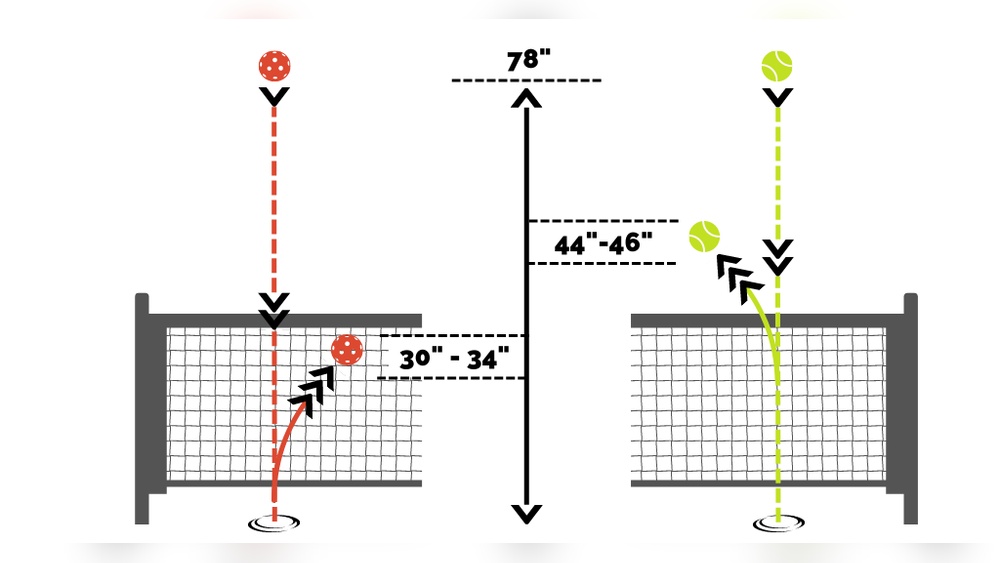
The most noticeable difference is net height. In pickleball, the net is lower than in tennis.
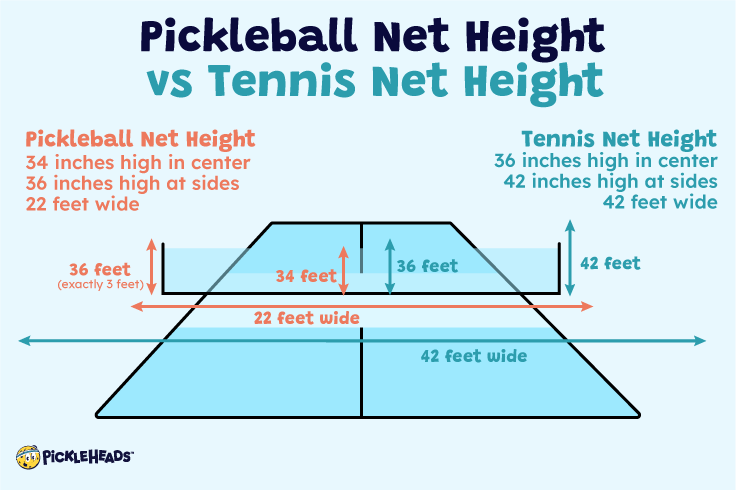
- Pickleball net height: 36 inches (91.4 cm) at the sidelines, 34 inches (86.4 cm) at the center.
- Tennis net height: 42 inches (106.7 cm) at the posts, 36 inches (91.4 cm) at the center.
This means the pickleball net is about 2 inches lower at the center than a tennis net. For context, the average pickleball paddle is about 16 inches tall, so the net is just over twice its height.
Net Width
Width is another major difference.
- Pickleball net width: 22 feet (6.7 meters)
- Tennis net width: 42 feet (12.8 meters) for doubles, 33 feet (10 meters) for singles
A tennis net covers almost double the width of a pickleball net. This changes the way players move and hit the ball.
Net Material
Most pickleball nets are made of durable nylon mesh with a vinyl or fabric headband. Tennis nets use a similar nylon or polyester mesh, but often with thicker cords and heavier-duty posts to support the wider net.
Court Size And Net Placement
A pickleball court is smaller: 20 feet wide and 44 feet long. A tennis court is 36 feet wide and 78 feet long for doubles. The net placement matches the width of the court in both sports.
Visual Comparison
Here’s a quick visual comparison of key measurements:
| Feature | Pickleball Net | Tennis Net |
|---|---|---|
| Net Height (Center) | 34 inches (86.4 cm) | 36 inches (91.4 cm) |
| Net Height (Posts) | 36 inches (91.4 cm) | 42 inches (106.7 cm) |
| Net Width | 22 feet (6.7 m) | 42 feet (12.8 m, doubles) |
| Mesh Material | Nylon or polyester | Nylon or polyester |
Why Net Height And Width Matter
The net’s size affects more than just setup. It directly impacts gameplay, tactics, and even the types of shots you can make.
- Lower net in pickleball: Allows faster volleys and encourages quick reactions at the net. Players rely more on control than power.
- Wider, higher net in tennis: Demands more powerful shots to clear the net, and players must cover more ground, especially in doubles.
In pickleball, the shorter net and narrower court mean the serve and volley game is more prominent. In tennis, lobs, passing shots, and baseline rallies are common because the net is higher and wider.
Understanding Net Construction
Both pickleball and tennis nets are made to be durable, but there are some differences in the way they are built.
Materials Used
- Pickleball nets: Usually made with a lightweight metal or powder-coated steel frame, nylon mesh netting, and a reinforced fabric headband. They are designed to be portable and easy to set up.
- Tennis nets: Heavier, with thicker steel cables running through the headband, and heavier-duty posts (often anchored in the ground).
Pickleball nets are often portable, while tennis nets are more likely to be permanent fixtures.
Net Tension
A key detail that beginners often miss is net tension. A loose net can sag, changing the ball’s bounce and sometimes even affecting the outcome of a game. Both pickleball and tennis require the net to be tight enough that the top band is straight.
- In tennis, regulations require the net to be tight enough that the center does not sag below 36 inches.
- In pickleball, the center is intentionally lower, but tension must be consistent across the net.
Net tension affects the way the ball rebounds after hitting the net – a tighter net gives a more predictable bounce.
Setting Up Each Net: Practical Steps
If you need to set up your own court, knowing the correct setup process is important.
How To Set Up A Pickleball Net
- Lay out the court lines: Make sure the area is 20 feet wide by 44 feet long.
- Assemble the net frame: Most portable pickleball nets have a snap-together frame.
- Attach the mesh net: Slide the netting over the top and bottom rods.
- Position the net: Place the posts 22 feet apart, directly on the sidelines.
- Adjust the height: Measure the net at the center – it should be exactly 34 inches.
- Tighten the straps: Pull the net tight so there is no sagging.
How To Set Up A Tennis Net
- Locate court center: Tennis courts are 36 feet wide (doubles), so the net must span 42 feet.
- Install posts: Posts are usually anchored outside the sidelines.
- Thread the cable: The steel cable runs through the net’s headband.
- Attach to posts: Secure both ends of the cable to each post.
- Tighten the net: Use a net crank to pull the cable tight.
- Adjust center height: Use a center strap to keep the middle of the net at 36 inches.
Tip: The most common mistake is not checking the center height. Even a small error can make play unfair.
Rules And Regulations For Each Net
Pickleball and tennis both have strict rules about nets, set by official organizations.
Pickleball Net Rules
The USA Pickleball association states:
- Net must be 22 feet wide and 36 inches high at the sidelines.
- Center height must be 34 inches.
- Net must extend fully from post to post.
- Posts cannot be more than 1 inch outside the sidelines.
If the net is not set up correctly, matches can be delayed or even canceled.
Tennis Net Rules
The International Tennis Federation requires:
- Net must be 42 feet wide (doubles), with posts 3 feet outside the doubles lines.
- Height at center must be 36 inches, and 42 inches at the posts.
- A strap at the center ensures correct height.
- Net must be tight and free of holes.
If the net is too low or high, officials will pause play until it is corrected.
Impact Of Net Differences On Gameplay
The differences in net height and width shape the entire flow of each sport.
Pickleball
- Shorter, lower net: Makes volleys and dinks (soft shots) more important.
- Easier to clear the net: Encourages faster exchanges at the net.
- Less room for powerful serves: Control and placement are more important than power.
Tennis
- Taller, wider net: Forces players to use more top-spin and power.
- Lobs and passing shots: More common because of the higher net.
- Net play is riskier: Approaching the net in tennis can be harder due to the greater height and width.
Insight: Many beginners do not realize that in pickleball, the lower net means even a slightly high shot can be attacked by your opponent, while in tennis, the higher net makes aggressive net play more challenging.
Credit: www.picklegeeks.com
Can You Use A Tennis Net For Pickleball (and Vice Versa)?
Many parks and schools want to use the same court for both sports. Is this possible?
- A tennis net is too high and wide for pickleball. You can sometimes lower the center with an adjustable strap, but the posts are too far apart.
- A pickleball net is too short and narrow for tennis. There is no way to stretch it to 42 feet for doubles tennis.
Some courts have multi-sport nets with adjustable heights. There are also portable pickleball nets that can be set up inside tennis courts. However, serious players prefer using the correct net for each sport, as even small changes can affect the game.
Durability And Maintenance
A high-quality net can last for years if cared for properly. However, the maintenance differs between the two sports.
- Pickleball nets: Often taken down and stored after use, especially on multi-use courts. Look for weather-resistant materials if playing outdoors.
- Tennis nets: Usually left outside for months at a time. The headband and cable may need tightening or replacement every season.
Practical tip: Always check your net before play. A torn mesh or loose cable can lead to unexpected interruptions or unfair points.
Cost Comparison
The price of nets varies widely based on quality and portability.
- Pickleball nets: Good portable nets cost between $80 and $250. Permanent nets can be more expensive if you add professional posts.
- Tennis nets: Range from $100 for basic models to over $400 for professional, tournament-grade nets.
If you are starting a club or managing a public court, budget for regular net replacement and consider weather-resistant options.
Portable Vs Permanent Nets
Another key difference is how often the nets are moved.
- Pickleball nets: Because many courts are shared spaces, portable nets are common. They are lighter and easy to assemble.
- Tennis nets: Most are permanent, with posts cemented into the ground. Some portable options exist, but they are heavy and less common.
If you want to play pickleball in your driveway or a gym, a portable net is best. For a dedicated tennis court, a permanent net is the standard.
Net Accessories And Upgrades
There are many accessories available for both types of nets.
Common Accessories
- Center straps: Ensure the net is the correct height in the middle.
- Net cranks: For tightening tennis nets.
- Ground sleeves: For permanent post installation.
- Weather covers: Protect the net from sun and rain.
- Replacement headbands: For when the top band wears out.
Upgrades
- Weighted bases: For extra stability on portable pickleball nets.
- Professional mesh: Thicker and less likely to tangle.
Advanced tip: For windy locations, look for nets with mesh designed to resist wind “sail” effects. This keeps the net stable and safe for play.
Adapting Courts For Both Sports
Many communities want to offer both pickleball and tennis on the same courts. There are several solutions.
- Temporary pickleball lines: Painted or taped onto tennis courts.
- Portable pickleball nets: Set up inside the tennis court.
- Multi-use net systems: Posts with two net heights.
One challenge is that the tennis net posts are wider apart than pickleball requires. This means you cannot use the same posts for both sports unless you install extra sleeves closer together for pickleball.
Real-world Example: Parks And Schools
Across the United States, schools and parks are converting tennis courts for pickleball use. According to the Sports & Fitness Industry Association, over 4.8 million Americans played pickleball in 2022, up 39% from the year before. Many courts now feature both tennis and pickleball lines.
- Pickleball nets are stored on site and set up as needed.
- Tennis nets remain in place for traditional tennis.
This dual use means players must be careful to use the right net for each sport. Recreational players sometimes play “mini tennis” using a pickleball net, but this is not official.
How Net Differences Affect Strategy
Net design changes the way you think about every point.
In Pickleball
- Shorter net: Makes drop shots and dinks more effective.
- Easier to play at the net: Players “kitchen” rules (non-volley zone) mean you can’t smash every shot, but quick hands win points.
- Lobs are risky: Because the net is low, it is easier for your opponent to reach a lob and put it away.
In Tennis
- Taller net: Encourages more use of spin and power.
- Approaching the net: Is a more advanced tactic, as passing shots are easier for your opponent.
- Overhead smashes: More common due to the greater net height.
Non-obvious insight: In pickleball, the lower net and slower ball mean that placement and accuracy are more important than power, while in tennis, raw speed and spin are often needed to win points at the net.
Common Mistakes When Choosing A Net
- Wrong size: Buying a tennis net for pickleball, or vice versa.
- Ignoring net tension: Not tightening the net enough for consistent play.
- Forgetting portability: Choosing a permanent net for a space that’s used for multiple sports.
- Neglecting weather resistance: Outdoor nets need UV and water protection.
- Overlooking accessories: Forgetting to buy a center strap for correct height.
Always measure your space and check the sport’s official rules before buying.
Quick Reference: Pickleball Net Vs Tennis Net
Here’s a side-by-side summary for easy reference:
| Aspect | Pickleball Net | Tennis Net |
|---|---|---|
| Height (Center) | 34 inches | 36 inches |
| Height (Posts) | 36 inches | 42 inches |
| Net Width | 22 feet | 42 feet |
| Court Size | 20×44 feet | 36×78 feet |
| Portability | Usually portable | Usually permanent |
| Common Material | Nylon mesh, fabric headband | Nylon/polyester mesh, vinyl headband |
Credit: www.pickleheads.com
Choosing The Right Net For Your Needs
When selecting a net, consider:
- Sport: Buy the correct net for pickleball or tennis—do not try to use one for both.
- Portability: Choose portable for shared spaces; permanent for dedicated courts.
- Weather resistance: Outdoor nets should resist sun and rain.
- Budget: Factor in replacement parts and accessories.
For official play, always use nets that meet USA Pickleball or International Tennis Federation standards.
Where To Buy Reliable Nets
You can find quality nets at sports retailers, specialty pickleball or tennis stores, and online. Look for models with good reviews, solid warranties, and clear assembly instructions. For more information on rules and standards, visit the Wikipedia Pickleball page.

Credit: www.pickleheads.com
Frequently Asked Questions
What Is The Main Difference Between A Pickleball Net And A Tennis Net?
The biggest differences are height and width. A pickleball net is 34 inches high at the center and 22 feet wide, while a tennis net is 36 inches high at the center and 42 feet wide for doubles.
Can I Use A Tennis Net For Pickleball?
You can try, but it is not ideal. A tennis net is too wide and too high for pickleball. Lowering the center helps, but the posts are still too far apart for official pickleball play.
How Do I Make A Tennis Court Suitable For Pickleball?
Add pickleball court lines (using tape or paint) inside the tennis court. Use a portable pickleball net that fits the 22-foot width, and set it up for games. Do not use the tennis net for official matches.
What Is The Best Material For Outdoor Nets?
For outdoor use, choose weather-resistant nylon or polyester mesh with a UV-protected headband. This keeps the net strong even in sun or rain.
How Often Should I Replace My Net?
Replace your net if you notice fraying, sagging, or broken cables. For most outdoor courts, this means every 2-3 years, but indoor and well-cared-for nets can last much longer.
Pickleball and tennis are both rewarding sports, but the right net makes all the difference. By understanding the details, you can enjoy the game more and avoid common setup mistakes. Whether you’re a new player or a seasoned pro, always check your net before you play—because a fair game starts with the right equipment.