
Pickleball has become one of the fastest-growing sports in the world. Players of all ages want to improve their game, and one popular way is by adding weights to their pickleball paddle. But where you put these weights can make a big difference. The placement affects power, control, and even comfort. If you are curious about how to add weights, where to place them, and what results you can expect, this guide explains everything in detail. By the end, you’ll know not just the “how,” but also the “why” behind paddle weighting, so you can make the best choice for your play style.
Why Add Weights To A Pickleball Paddle?
Adding weight to your paddle is not just about making it heavier. The main reasons players add weights are to:
- Increase power: Heavier paddles can hit the ball harder.
- Control balance: Weight placement changes how the paddle feels in your hand.
- Reduce vibration: Added weight can help absorb shock, which can reduce arm pain.
- Customize feel: You can adjust the paddle’s performance to match your unique style.
Many professional players use lead or tungsten tape for this purpose. With the right approach, even beginners can benefit from a customized paddle.
Types Of Weights Used
Before learning about where to put the weights, you should know what kind of weights you can use. The two most common types are:
- Lead Tape: This is the standard for most players. It is thin, flexible, and easy to attach to the paddle.
- Tungsten Tape: Heavier than lead tape, so you need less. It is more expensive but less toxic.
- Weighted Grips/Overgrips: Some overgrips come with extra weight built in.
- Edge Guard Weights: Some paddles allow you to add weighted guards around the edge.
Each type has its own pros and cons. Lead tape is easy to use and affordable, while tungsten tape is safer and more compact.
Rules And Regulations
The USA Pickleball Association (USAPA) allows players to add weights to their paddles as long as:
- The paddle does not exceed the maximum weight limit (usually around 8.5 ounces, but always check with the tournament or club).
- The surface of the paddle is not changed in a way that adds grip or spin beyond the rules.
- The weights are securely attached and do not come off during play.
Always check the latest guidelines before modifying your paddle, especially for tournament play.
Key Paddle Balance Types
The balance of a paddle refers to how its weight is distributed. There are three main types:
- Head-Heavy: More weight towards the top (head) of the paddle.
- Handle-Heavy: More weight towards the grip.
- Even-Balanced: Weight is distributed equally.
Each balance type affects play in unique ways.
Head-heavy
A head-heavy paddle delivers more power, especially on drives and overhead shots. However, it can feel less maneuverable for quick net play or reaction volleys.
Handle-heavy
A handle-heavy paddle is easier to control. It’s great for dinks and soft shots but can lose some punch on hard hits.
Even-balanced
Even-balanced paddles give a mix of power and control. Many players prefer this for its versatility.
Main Weight Placement Areas On A Pickleball Paddle
Knowing where to add weights is the heart of paddle customization. Here are the main areas:
- Top of the Paddle (Head)
- Sides (3 and 9 o’clock)
- Handle/Grip
- Throat or Neck Area
- Edge Guard (Entire Perimeter)
- Bottom of the Paddle (6 o’clock)
- Custom/Split Placement
Let’s look at each area in detail, how weight placement affects play, and what kind of players benefit most.
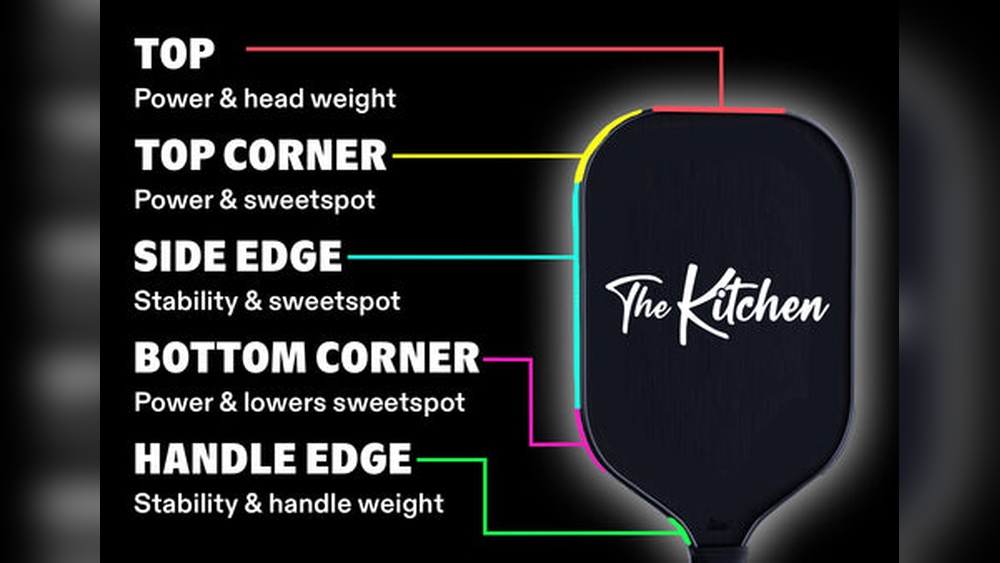
1. Top Of The Paddle (head)
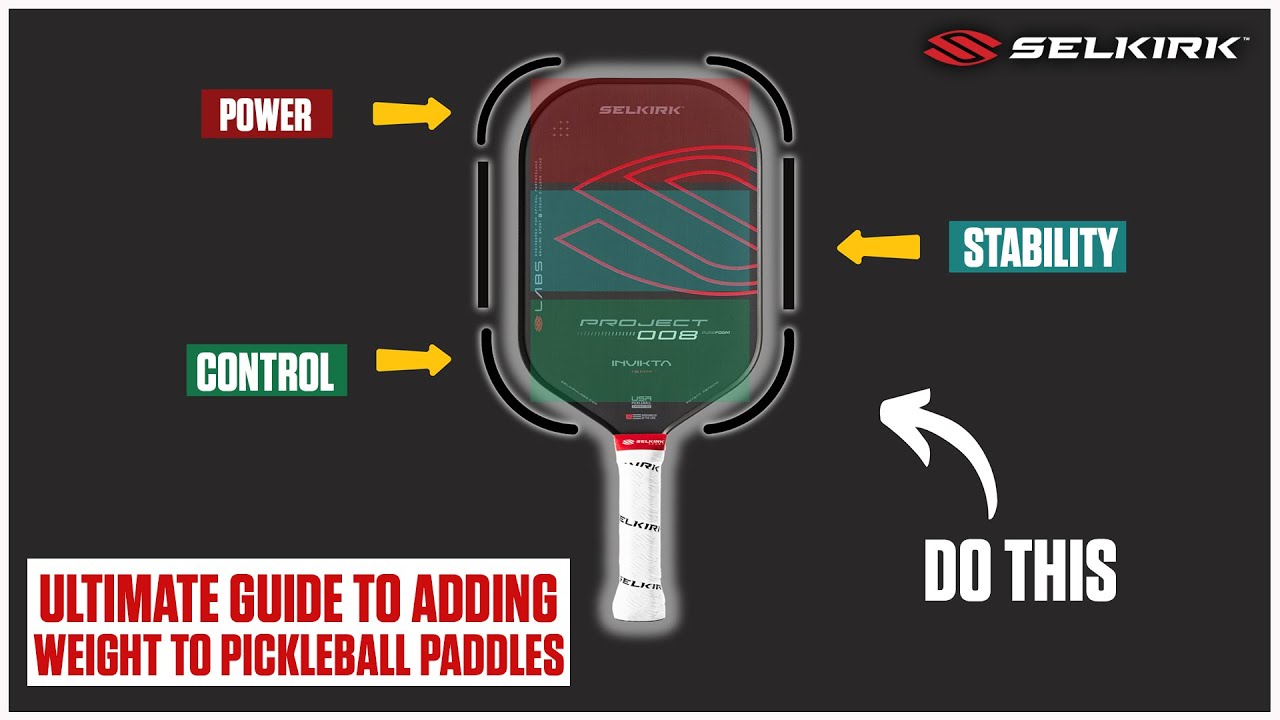
Adding weight to the top edge (the head) increases the swing weight of your paddle. This means the paddle will feel heavier during your swing, producing more power, especially on groundstrokes and overhead smashes.
Effects
- More power: Shots feel heavier and travel faster.
- Less maneuverability: Harder to make quick changes at the net.
- Added momentum: Good for players who like to finish points with strong hits.
Who Should Use This?
Players who rely on baseline shots, powerful drives, or overheads will benefit. Beginners may find it tiring, as it requires more wrist and arm strength. If you feel your shots are too soft or you struggle to put balls away, try adding weight here.
How To Apply
Use a strip of lead or tungsten tape (usually 4–6 inches long) and attach it along the very top of the paddle. Press it down firmly so it does not peel off during play.
Pro Tip
Don’t add too much at once. Start with a short strip, test it for a few games, and add more if needed.
2. Sides Of The Paddle (3 And 9 O’clock)
Placing weights on the sides (right and left edges, also called the 3 and 9 o’clock positions) helps with paddle stability. It makes the paddle less likely to twist in your hand when hitting off-center shots.
Effects
- Increased stability: Reduces twisting on mishits.
- Better control: Especially helpful for blocking and volleying.
- Slight power boost: But less than adding weight to the top.
Who Should Use This?
Players who struggle with off-center hits or want more control at the net. Defensive players and those who like consistent blocks and dinks often prefer this placement.
How To Apply
Attach strips of tape on both sides, ideally in equal lengths and thicknesses. This keeps the paddle balanced and avoids pulling to one side.
Non-obvious Insight
Many players only add weight to one side by mistake, which can make the paddle feel unbalanced. Always add the same amount to both sides unless you have a specific reason.
3. Handle/grip
Adding weight to the handle or grip shifts the balance towards your hand. This makes the paddle feel lighter and easier to control. It won’t increase power much, but it can make quick shots and resets easier.
Effects
- Faster hand speed: Great for quick volleys and reaction shots.
- Reduces fatigue: Less strain on the wrist for some players.
- Less power: Not ideal if you want to hit harder.
Who Should Use This?
Players who want more paddle control or who have wrist or elbow issues. If you play a lot at the kitchen line, this can help with quick exchanges.
How To Apply
Use a weighted overgrip or wrap lead tape under your grip tape. Make sure it is wrapped smoothly to avoid bumps that can irritate your hand.
Non-obvious Insight
Adding weight here can help balance a paddle that already feels too head-heavy from the factory.

Credit: pickleballstudio.com
4. Throat Or Neck Area
Some paddles have a throat or neck just above the handle. Adding weight here gives a mix of both power and control.
Effects
- Balanced feel: Not as extreme as adding only to the head or handle.
- Smoother swings: Can help with timing and follow-through.
Who Should Use This?
Players who can’t decide between power and control, or who want a “middle ground. ” If your paddle feels too “whippy,” this can settle it down.
How To Apply
Apply a short piece of tape just above the handle, on both sides if possible. Test after each change.
5. Edge Guard (entire Perimeter)
Some players put tape around the entire edge of the paddle, under the edge guard if possible. This adds weight evenly all around.
Effects
- Uniform stability: Paddle feels more solid on all shots.
- Slight power boost: But not as much as top-only weighting.
- Increased swing weight: Paddle feels heavier overall.
Who Should Use This?
Players who want an overall heavier paddle without changing balance too much. If you like a “solid” feel but don’t want to lose control, this is a good option.
How To Apply
Cut strips of tape and press them under the edge guard, or wrap them around the rim if the guard cannot be removed.
6. Bottom Of The Paddle (6 O’clock)
Adding weight to the very bottom edge makes the paddle more handle-heavy. It is less common, but some players use it to counterbalance a head-heavy paddle or to reduce strain on the arm.
Effects
- Easier maneuverability: Paddle feels quicker in hand.
- Reduced power: Not for those who want more punch.
Who Should Use This?
Players who feel their paddle is too top-heavy or who want to protect their arm from fatigue.
How To Apply
Attach tape to the bottom edge, under the grip if possible. Test with a small amount first.
7. Custom/split Placement
Advanced players sometimes use a split weighting system, adding tape in several spots for a fine-tuned balance. For example, a player might add a little tape to the head and a little to the sides for both power and stability.
Effects
- Personalized balance: You control exactly how the paddle feels.
- Takes time to perfect: Best for those who are willing to experiment.
Who Should Use This?
Players who want the perfect feel and are not afraid to test different combinations. This approach can give the best results but requires patience.
How To Apply
Add small strips in several areas, always in equal amounts on both sides to avoid twisting. Play a few games, then adjust as needed.
How Weight Placement Affects Play: Data And Comparisons
To help you see the differences, here is a comparison of three common weight placements and their effects:
| Weight Placement | Power | Control | Stability | Maneuverability |
|---|---|---|---|---|
| Top (Head) | High | Medium | Medium | Low |
| Sides (3/9 o’clock) | Medium | High | High | Medium |
| Handle | Low | High | Medium | High |
As you can see, there is always a trade-off. Adding weight to the head increases power but reduces maneuverability. Adding to the handle does the opposite.
Step-by-step: How To Add Weights To Your Paddle
- Choose your tape: Lead or tungsten, depending on preference.
- Clean the paddle: Wipe the surface where you will apply the tape.
- Cut the tape: Start with 2–4 inch strips. You can always add more.
- Apply the tape: Place it on your chosen spot, pressing firmly.
- Test the paddle: Play a few games and take notes on how it feels.
- Adjust as needed: Add or remove tape until you find your perfect balance.
- Secure the tape: For extra security, wrap a clear tape or edge guard over the weight.
Example
If you want more power, start by placing a 4-inch strip on the top edge. If you want more control, try two strips (2 inches each) on the sides. Always test after each change.

Credit: www.speakpickleball.com
Mistakes To Avoid When Adding Weights
Even experienced players can make errors when adding weight. Here are some common mistakes:
- Adding too much at once: Makes the paddle feel awkward or illegal for tournaments.
- Unbalanced placement: Tape on one side only can cause twisting.
- Ignoring comfort: Bulky tape under the grip can cause blisters.
- Not testing regularly: Play at least 2–3 games after each change.
- Skipping rules check: Always confirm your paddle is legal for tournament play.
How Much Weight Is Too Much?
Most paddles weigh between 7. 5 and 8. 5 ounces out of the box. Adding 0. 1 to 0. 3 ounces (2. 8 to 8. 5 grams) with tape is common. More than 0. 5 ounces can make the paddle feel sluggish and may not be allowed in competition.
Weight Comparison Table
Here’s how different weights feel in play:
| Paddle Weight (oz) | Power | Control | Fatigue Risk |
|---|---|---|---|
| 7.5–7.9 | Low | High | Low |
| 8.0–8.3 | Medium | Medium | Medium |
| 8.4–8.8 | High | Low | High |
Most players find their “sweet spot” in the 8. 0–8. 3 ounce range, but advanced players may go heavier for more power.
Practical Tips For Successful Paddle Weighting
- Start small: Add a little tape, then build up.
- Symmetry matters: Always add the same amount to each side for balance.
- Mark your changes: Keep track of what you change, so you can go back if needed.
- Check grip comfort: If you add weight to the handle, make sure the grip stays comfortable.
- Re-check after long sessions: Sometimes a paddle feels fine at first, but causes fatigue after an hour.
When To Change Your Weight Setup
You might need to adjust your weights if:
- You change playing styles (e.g., from control to power focus)
- You recover from injury (lighter setups help reduce strain)
- You switch to a different paddle model
- You start playing in tournaments (rules may be stricter)
How Pros Use Paddle Weighting
Many professional pickleball players use lead tape to fine-tune their paddles. For example, some top pros add tape to the head for more drive on serves and smashes. Others add to the sides for a stable “blocking” paddle. Watching how top players adjust their gear can give you ideas for your own setup.
For more details on paddle customization and rules, visit the official USA Pickleball Association website.
Frequently Asked Questions
Where Exactly Should I Put The Weight For More Power?
For more power, add weight to the top edge (head) of your paddle. This increases swing weight, letting you hit harder with less effort. Start with a small strip and add more as needed.
How Do I Know If My Paddle Is Too Heavy After Adding Weights?
If your arm or wrist gets tired quickly, or if you notice slower reactions at the net, your paddle may be too heavy. Most players do best with a total paddle weight under 8.5 ounces.
Can I Use Regular Tape Instead Of Lead Or Tungsten Tape?
No, regular tape does not add enough weight. Lead tape and tungsten tape are specially made for adding weight without being bulky. Always use purpose-built tape for best results.
Is It Legal To Add Weights For Tournament Play?
Yes, as long as the paddle stays within official weight and surface rules. Always check with the tournament or club before playing to avoid disqualification.
Will Adding Weight Help With Tennis Elbow Or Arm Pain?
Adding weight to the handle or sides can help absorb vibration and reduce arm pain. However, too much weight can make things worse, so always start small and consult a coach or doctor if you have ongoing pain.
Pickleball paddle weighting is both science and art. By understanding where to put weights and how each placement affects play, you can create a paddle that fits you perfectly. Experiment, be patient, and enjoy your improved game on the court.
Credit: www.selkirk.com